Ever wonder why your high-end processor suddenly slows to a crawl when you are rendering a massive video, compiling complex code, or running a heavy AI workload? It is all about heat. But the way our current hardware manages that heat is surprisingly primitive. Modern chips are practically flying blind, reacting to temperature spikes after the physical limits are already being tested. Fortunately, a massive breakthrough in nanotechnology might just change how our silicon handles the heat forever.
Why do modern processors struggle with heat detection?
Right now, the processors powering everything from our smartphones to massive data centers contain billions of densely packed transistors. Naturally, these microscopic components generate significant heat when they are hard at work. Here is the catch: the thermal sensors responsible for monitoring that heat are not actually located inside the active circuitry.
Instead, manufacturers are forced to place these sensors outside the chip die. This physical gap creates a dangerous latency. Individual transistors can overheat much faster than the external sensors can register the temperature change. As Saptarshi Das, a Professor of Engineering Science at Penn State, points out: “These chips rapidly heat up during usage, but the sensors that monitor their temperatures are not embedded within the chip.”
Because of this blind spot, hardware manufacturers have to play it incredibly safe. Rather than managing localized hotspots, they rely on conservative thermal throttling across entire processor cores. Basically, they slow down the whole neighborhood just because one single house is getting a little too warm.
How do 2D microscopic temperature sensors work?
That is exactly where a fascinating new piece of research comes in. Published in Nature Sensors on March 6, 2026, a collaborative team from Penn State University, the University of Chemistry and Technology Prague, and Northwestern University has developed a revolutionary microscopic temperature sensor.
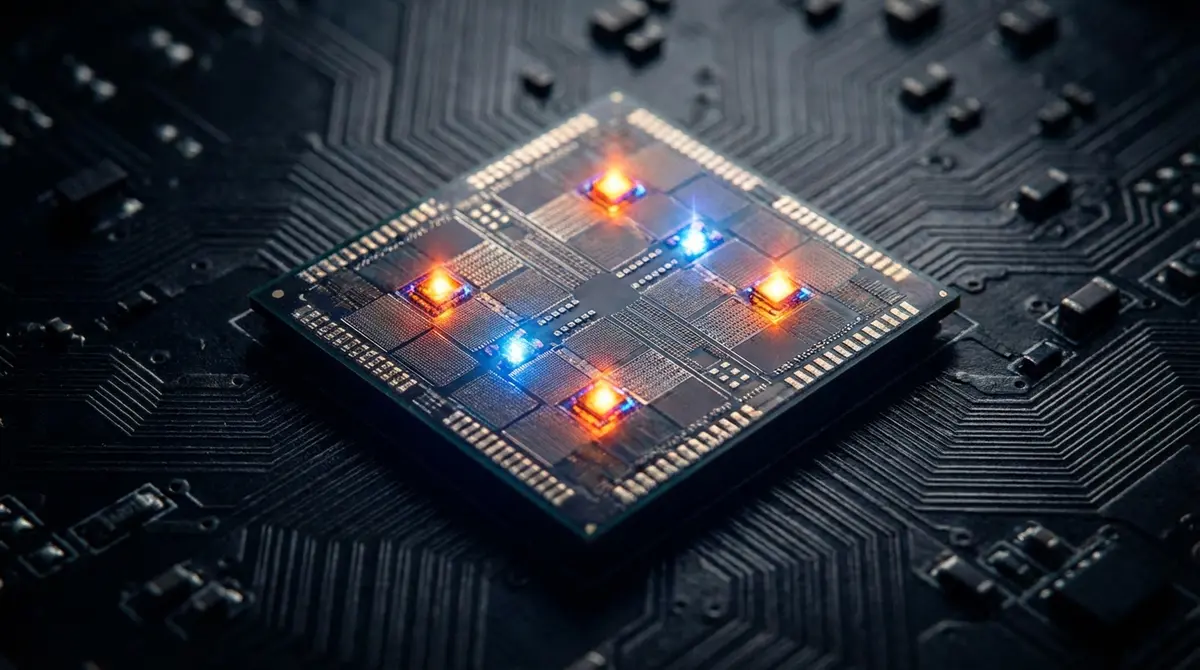
These new sensors are made from bimetallic thiophosphates, a highly novel 2D material. By uniquely coupling ion and electron transport, these atom-thin thermometers can detect temperature changes in an astonishing 100 nanoseconds. To put that into perspective, that is millions of times faster than the blink of an eye. Because they measure just one square micrometer, they can be embedded directly into the processor chips right alongside the active transistors.
Interestingly, the researchers used a clever approach to make this work. “What is generally unwanted by industry in transistors actually is great for thermal sensing, so we really tried to exploit that in our design,” explained Professor Das. Alongside doctoral candidate Dipanjan Sen, the Penn State team figured out how to turn a traditional semiconductor flaw into a specialized thermal monitoring superpower.
How much better are 2D sensors than silicon-based thermal sensors?
When you compare these new 2D microscopic sensors to conventional silicon-based thermal sensors, the differences are absolutely staggering. First and foremost, the bimetallic thiophosphate sensors are over 100 times smaller than their silicon counterparts. This size reduction is exactly what allows them to be slipped directly into the active processor die.
More importantly, they are up to 80 times more power-efficient. This is a critical detail for semiconductor engineering. When you are trying to measure heat, the last thing you want is a sensor that consumes so much power that it generates its own thermal footprint. By barely sipping power, these 2D sensors provide ultra-accurate readings without adding unnecessary energy overhead to the processor itself.
This development does not exist in a vacuum, either. The semiconductor manufacturing world is seeing a wave of highly specialized material breakthroughs right now. According to reports, UNIST recently developed low-noise clock generator circuits, while KAIST created carbon nanotube sandpaper for atomic-level processing of semiconductor surfaces. We are entering an era where chip manufacturing is being optimized down to the single atom, and thermal management is finally catching up.
What This Really Means
High-performance computing and AI hardware companies are the undeniable winners here, as this technology unlocks raw processing power that is currently trapped behind artificial thermal limits. Traditional silicon sensor manufacturers will need to pivot fast or risk obsolescence in the next few chip generations. By allowing near-real-time, transistor-level thermal mapping without significant energy bloat, chip designers can finally abandon blind, core-wide throttling and push processors right to the absolute physical edge of their capabilities.
![Illustration related to 100ns 2D Thermometers Stop Thermal Throttling [Explained]](https://bytewire.press/wp-content/uploads/bytewire-images/2026/03/atom-thin-2d-thermometers-processor-thermal-throttling-efd7c13770.webp)
![Diagram related to 100ns 2D Thermometers Stop Thermal Throttling [Explained]](https://bytewire.press/wp-content/uploads/bytewire-images/2026/03/atom-thin-2d-thermometers-processor-thermal-throttling-d1afadb5ed.webp)