Have you ever wondered what it actually takes to power the AI revolution? We often talk about chips and chatbots, but the invisible backbone of artificial intelligence is electricity—massive amounts of it. That’s exactly where the Adani Group is placing a colossal bet.
In a move that signals a major pivot for India’s tech ecosystem, the conglomerate has pledged a staggering $100 billion investment by 2035 to build AI-ready data centers. This isn’t just about building server farms; it’s about transforming India from a software service exporter into a hard infrastructure heavyweight.
The plan targets a capacity of up to 5 gigawatts (GW), scaling up significantly from previous targets. To put that in perspective, that’s enough power to light up millions of homes, but here, it’s destined for the power-hungry processors driving the next generation of AI.
Why is Adani pivoting so hard into AI infrastructure?
You might ask why an infrastructure giant is diving so deep into tech. The answer lies in the execution strategy. This initiative will be led by AdaniConneX, a joint venture with EdgeConneX. It’s a calculated play to capture the physical layer of the AI stack.
The group isn’t going it alone, either. They have lined up heavy hitters like Google, Microsoft, and Flipkart for anchor tenancy and technology partnerships. By securing these strategic partners early, Adani is effectively building the highway that the world’s biggest tech companies will need to drive on.
![Illustration related to Adani's $100B AI Data Center Investment: The Plan [Analysis]](https://bytewire.press/wp-content/uploads/bytewire-images/2026/02/adani-100b-ai-data-center-investment-india-6decd25f05.webp)
According to market analysts, this move is expected to catalyze an additional $150 billion in related industries, such as server manufacturing. It’s a classic ecosystem play: build the facility, and the supply chain will follow.
Can renewable energy solve the AI power crunch?
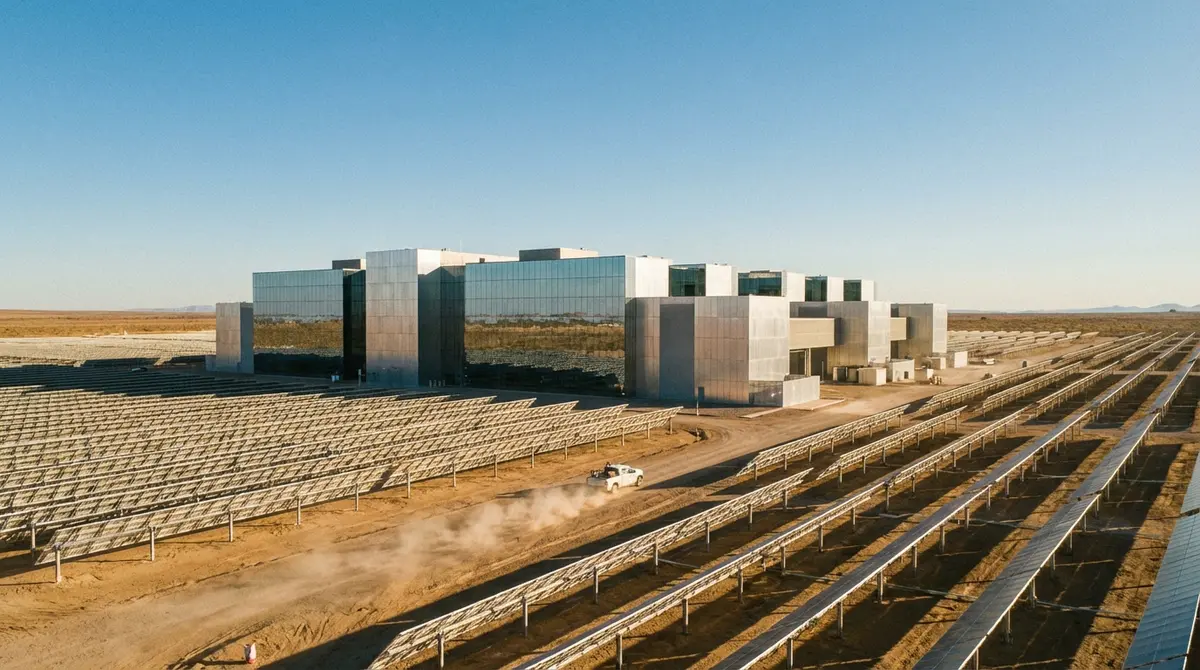
Here is the really interesting part: the bottleneck for AI right now isn’t just silicon; it’s the electric grid. AI data centers consume exponentially more power than traditional ones. Gautam Adani, the group’s chairman, hit the nail on the head when he said, “Nations that master the symmetry between energy and compute will shape the next decade.”
![Diagram related to Adani's $100B AI Data Center Investment: The Plan [Analysis]](https://bytewire.press/wp-content/uploads/bytewire-images/2026/02/adani-100b-ai-data-center-investment-india-de8b1e882a.webp)
Get our analysis in your inbox
No spam. Unsubscribe anytime.