In a rare deviation from its decades-old investment strategy, Benchmark Capital has raised at least $225 million through special-purpose vehicles to increase its stake in AI chipmaker Cerebras Systems. The move signals an extraordinary level of conviction from one of Silicon Valley’s most disciplined firms, positioning Cerebras as a formidable contender in an AI hardware market dominated by Nvidia.
According to filings and reports, the new capital was raised via two entities dubbed “Benchmark Infrastructure.” This investment flows into a larger $1 billion Series H funding round led by Tiger Global, which now values Cerebras at approximately $23 billion. This valuation marks a near-tripling of the company’s worth from just six months ago, when it was valued at $8.1 billion in September 2025.
Why is Benchmark breaking its investment tradition?
Benchmark Capital is renowned in the venture capital world for its “small fund” philosophy. The firm typically caps its flagship funds at around $450 million and famously avoids the asset aggregation strategies used by growth-stage giants like Andreessen Horowitz or Sequoia. By keeping fund sizes manageable, Benchmark usually focuses on early-stage, high-ownership bets where individual partners dedicate significant time to a handful of companies.
Creating a dedicated $225 million sidecar fund specifically for one portfolio company is a significant departure from this norm. Benchmark has been an investor in Cerebras since leading the company’s Series A round in 2016. General Partner Eric Vishria, a key figure in the firm, has championed Cerebras’ potential for nearly a decade. The decision to raise outside capital specifically to maintain or increase ownership in a Series H round suggests that Benchmark views Cerebras not merely as a successful exit waiting to happen, but as a generational company capable of delivering returns that justify breaking institutional protocol.
How does this impact Cerebras’ valuation and IPO timeline?
The infusion of capital comes at a critical juncture for Cerebras. The company’s valuation has skyrocketed to $23 billion, a figure that reflects the insatiable demand for AI infrastructure. This resurgence follows a turbulent period in late 2024.
Cerebras had previously filed for an IPO with plans to go public in October 2024. However, the offering was withdrawn following regulatory delays involving the Committee on Foreign Investment in the United States (CFIUS). The scrutiny centered on Cerebras’ ties to G42, a UAE-based investor and key customer. With those inquiries reportedly resolved, the new funding provides Cerebras with a substantial war chest to navigate the private markets before a renewed attempt at a public listing.
Current reports indicate that Cerebras is targeting a potential IPO in mid-to-late 2026. The involvement of late-stage heavyweights like Tiger Global alongside Benchmark suggests high confidence that the public markets will be receptive to a pure-play AI hardware alternative to Nvidia.
ByteWire Analysis: The Signal in the Noise
By the ByteWire Editorial Board
Benchmark’s maneuver is the strongest possible validation of the “Sovereign AI” thesis. While Nvidia remains the undisputed king of the hill, the tech ecosystem is desperate for a viable second option to prevent a total monopoly on training compute. Benchmark does not chase hype cycles with late-stage capital; they are strictly early-stage DNA. For them to mobilize nearly half the size of a standard core fund for a single late-stage bet implies they have seen internal metrics—likely related to power efficiency and training speed—that convince them Cerebras is the only true competitor to Nvidia’s H-series and Blackwell chips.
What role does the OpenAI deal play in this funding?
The catalyst for this massive valuation jump appears to be a landmark commercial agreement. Cerebras recently secured a multi-year compute deal with OpenAI, rumored to be worth in excess of $10 billion. This partnership likely served as the foundational proof point for the Series H investors.
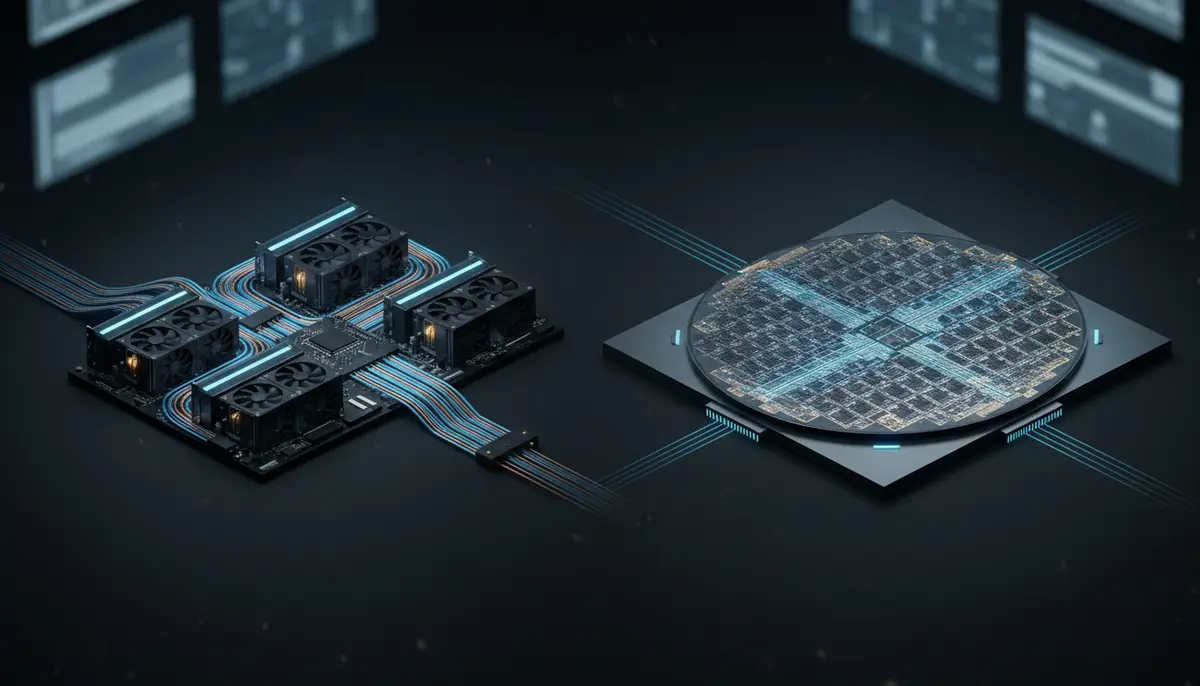
Cerebras distinguishes itself with its “Wafer Scale Engine” (WSE) technology. Unlike Nvidia, which links many smaller GPUs together, Cerebras builds a single massive chip the size of a dinner plate. This architecture theoretically reduces the latency and power consumption associated with moving data between thousands of separate GPUs—a critical bottleneck in training massive Large Language Models (LLMs). The OpenAI deal suggests that the WSE architecture has graduated from an experimental novelty to a production-grade necessity for the world’s leading AI labs.
What This Means
The $23 billion valuation sets a high bar for Cerebras’ eventual IPO. For the broader market, this funding round confirms that the AI hardware wars are far from over. While hyperscalers like Google and Amazon are building their own custom silicon, the venture capital community is betting heavily that there is room for an independent merchant silicon provider to challenge Nvidia. With Benchmark and Tiger Global doubling down, Cerebras has the capital to scale manufacturing and software development, setting the stage for a high-stakes public debut in 2026.