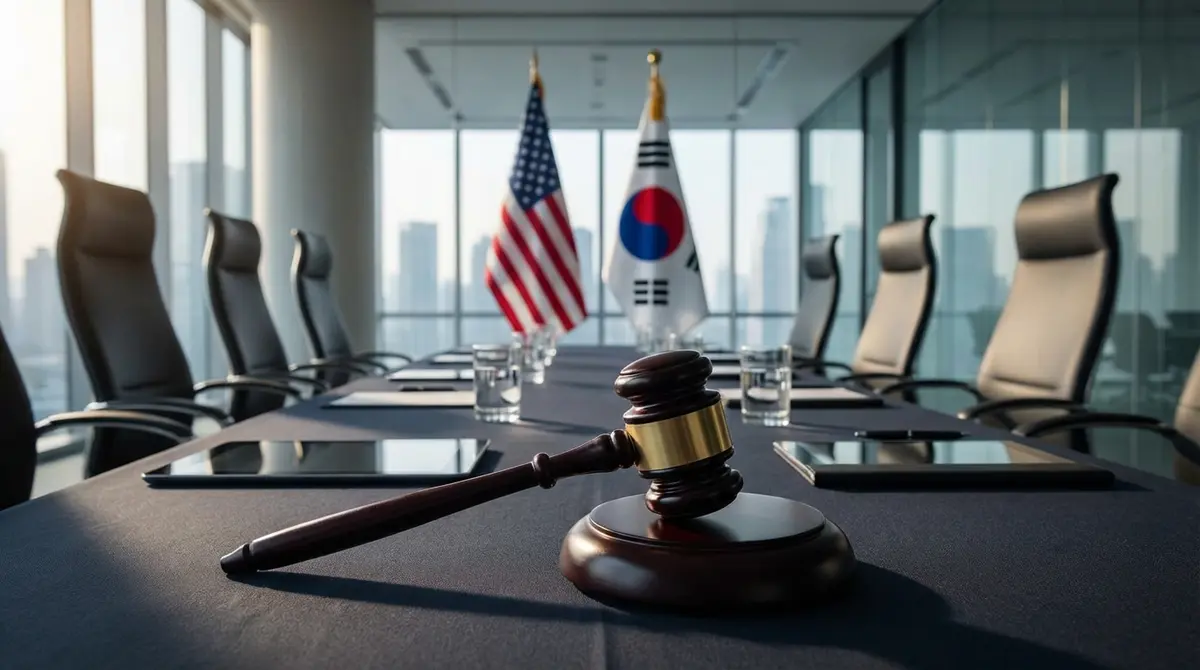
It isn’t every day that a group of Wall Street heavyweights teams up to sue a sovereign nation, but that is exactly the high-stakes drama currently unfolding between U.S. capital markets and the South Korean government. On February 12, 2026, the conflict escalated significantly as three more U.S. investment firms—Abrams Capital, Durable Capital Partners, and Foxhaven Asset Management—joined an Investor-State Dispute Settlement (ISDS) claim against Seoul.
At the heart of this dispute is Coupang, often dubbed the "Amazon of South Korea." While the company operates primarily in Korea, it is listed on the NYSE, making it a U.S. company in the eyes of international trade law. Following a massive data breach disclosed in late 2025, investors allege that South Korean regulators responded not with standard enforcement, but with "discriminatory" and "defamatory" actions that tanked the stock price and wiped out billions in market value.
What triggered the investor lawsuit against South Korea?
The catalyst for this legal explosion was a filing on February 12, 2026. The three new firms joined existing plaintiffs Greenoaks Capital and Altimeter Capital to leverage a specific mechanism in the KORUS FTA (Free Trade Agreement). This mechanism, known as ISDS, allows foreign investors to sue governments if they believe discriminatory practices have harmed their investments.
According to a joint statement from the U.S. investors, the South Korean government engaged in "years of selective government enforcement" and spread "false and defamatory claims" regarding Coupang’s operations. The financial impact has been brutal: Coupang’s stock (CPNG) plummeted over 30% in the wake of the regulatory crackdown, inflicting massive losses on these major shareholders.
This isn’t the first time foreign funds have used ISDS against Seoul—firms like Lone Star and Elliott Management have walked this path before—but the scale and speed of this coalition suggest a new level of aggression from U.S. capital.
How severe was the Coupang data breach?
To understand the government’s heavy-handed response, you have to look at the scale of the leak. The breach, disclosed in late 2025, was catastrophic by any metric. It compromised the personal data of 33.7 million users. To put that in perspective, that is more than half the entire population of South Korea.
The technical cause of the breach was alarmingly simple. Research indicates that a former employee—a developer—used unrevoked cryptographic keys to access the data. This lapse in security protocol has handed ammunition to regulators like the Personal Information Protection Commission (PIPC) and the Ministry of Science and ICT.
Regulators are currently reviewing a potential fine of up to 1 trillion won (approximately $770 million) against Coupang for violations of the Personal Information Protection Act. If enforced, this would be a record-breaking penalty, signaling that South Korea’s strict privacy laws are not just for show.
Is South Korea unfairly targeting U.S. companies?
This is the billion-dollar question. The South Korean Ministry of Justice maintains that they responded to the leak "in accordance with due process and there was no discrimination." However, the investors argue that the intensity of the regulatory scrutiny is disproportionate and specifically targets Coupang because of its foreign listing status.
The situation has become so heated that investors have petitioned the U.S. Trade Representative (USTR) to investigate South Korea under Section 301 of the Trade Act for unfair treatment of U.S. companies. Furthermore, the U.S. House Judiciary Committee has issued a subpoena to Coupang leadership to testify regarding foreign regulatory targeting.
While South Korean police conduct a criminal investigation into the former developer responsible for the theft, the political narrative has shifted. It is no longer just about data privacy; it is about whether Seoul is hostile to foreign-owned platforms.
What does this mean for future tech IPOs?
The fallout from this battle is already spilling over into the broader market. Market analysts warn that this U.S.-South Korea disagreement could become a "turning point in bilateral relations." The immediate casualty could be other South Korean tech giants hoping to list in New York.
Specifically, the anticipated 2026 Nasdaq IPO of Viva Republica, the operator of the fintech giant Toss, is now facing headwinds. If U.S. investors perceive South Korea as a hostile regulatory environment where the government might arbitrarily devalue foreign-held assets, the appetite for upcoming Korean listings could evaporate. The legal battle is creating significant trade friction that could freeze cross-border tech investments for years.
The Bottom Line
This lawsuit is a double-edged sword that exposes the fragility of cross-border tech giants. While Coupang’s security failure regarding unrevoked keys is inexcusable, the South Korean government’s aggressive potential fine of nearly $1 billion smells of protectionism disguised as privacy enforcement. If Seoul pushes this fine through, they might win a short-term populist victory, but they risk alienating the very U.S. capital that fuels their tech ecosystem—potentially killing the IPO dreams of companies like Viva Republica before they even ring the bell.
![Illustration related to Coupang Data Breach Lawsuit: US Firms Sue Korea [Analysis]](https://bytewire.press/wp-content/uploads/bytewire-images/2026/02/coupang-data-breach-lawsuit-south-korea-isds-claim-684283d32f.webp)
![Diagram related to Coupang Data Breach Lawsuit: US Firms Sue Korea [Analysis]](https://bytewire.press/wp-content/uploads/bytewire-images/2026/02/coupang-data-breach-lawsuit-south-korea-isds-claim-ec7b5e6f1a.webp)