If you have ever flown a DJI drone, you know the feeling: the uncanny stability, the way it refuses to crash into trees, and the sheer polish of the software. Now, imagine taking that autonomous brain, stripping away the propellers, and strapping it to a vacuum cleaner. That is exactly what the world’s largest drone maker has done.
On October 28, 2025, DJI officially entered the smart home chat with the launch of the Romo series in Europe. It is a fascinating pivot for a company that has spent the last decade owning the skies. But here is the catch: while European tech enthusiasts are unboxing what might be the most powerful robot vacuum ever made, American consumers are left out in the cold.
I have been tracking the robotics market for years, and usually, a launch like this would be a global blitz. The fact that the flagship Romo P has no US release date speaks volumes about the current state of tech geopolitics. But before we get into the trade wars, let’s look at the machine itself, because the specs are frankly ridiculous.
What makes the Romo P different from a Roborock or Roomba?
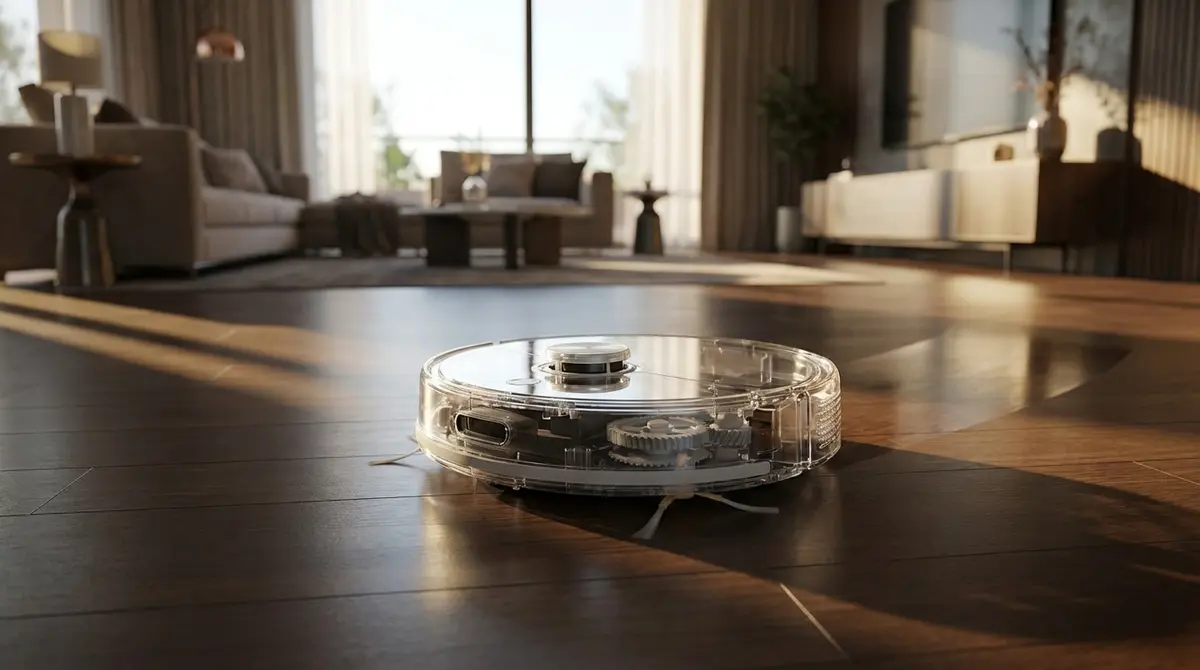
Most robot vacuums look the same: a black or white puck that bumps around your house. DJI has taken a different approach with the Romo P, giving it a transparent aesthetic that shows off the internal engineering. It is a bold branding move designed to separate this device from the aerial products while screaming "look at our tech."
But the real story is the power. The Romo P boasts a staggering 25,000 Pa of suction. To put that in perspective, high-end competitors from Roborock and Dreame typically top out between 10,000 and 18,000 Pa. That is a massive jump in raw power, likely leveraging DJI’s deep experience with high-performance electric motors.
Beyond the muscle, the Romo P features a self-cleaning base station with hot water washing—a feature that is quickly becoming standard in the premium tier. It also introduces dual extendable arms for corner cleaning, directly challenging similar innovations we have seen recently from its Chinese rivals. Essentially, DJI looked at the market leaders, matched their best features, and then dialed the motor power up to eleven.
How does drone technology translate to cleaning floors?
This is where things get interesting. Navigating a living room isn’t all that different from navigating a forest—you need to see obstacles and avoid them in real-time. The Romo P utilizes what DJI calls "drone-grade" obstacle avoidance. This system combines dual fisheye cameras with solid-state LiDAR.
Solid-state LiDAR is a big deal because it is generally more durable and compact than the spinning turrets you see on many current bots. By integrating this with the same computer vision algorithms that keep a Mavic drone from slamming into a wall, DJI claims to offer superior navigation.
They have also included a specific "pet area mode," which presumably tweaks the navigation behavior to handle the chaotic elements of living with animals. It is a smart inclusion that acknowledges the primary demographic for these high-end devices: pet owners tired of constant shedding.
Why is the DJI Romo not available in the US?
So, if this thing is so advanced, why can’t you buy it in New York or San Francisco? The answer lies in the increasingly tense relationship between Washington and Shenzhen. DJI is currently on the US Entity List, which restricts its business operations and access to certain technologies.
While DJI dominates the consumer drone market in the US, the scrutiny from the US government has been intensifying. There are ongoing concerns regarding Chinese-made autonomous devices and LiDAR technology, with fears centering on data privacy and national security. This has created a hostile environment for a new product category launch.
Competitors like Roborock and Dreame are also Chinese companies, but they established their US foothold before the geopolitical temperature reached its current boiling point. DJI’s entry now forces them to navigate a minefield of potential import bans and regulatory pushback. Consequently, the Romo series—comprising the S, A, and flagship P models—is currently a Europe-first affair. Reports suggest the lack of a US launch date is a direct strategic calculation to avoid dead-on-arrival inventory should new restrictions drop.
The Bottom Line
DJI’s entry into the home robotics market is a disruptive force that exposes the widening rift in the global tech landscape. By bringing 25,000 Pa suction and drone-grade vision to a vacuum, DJI has technically outclassed the competition on day one, proving their engineering prowess extends far beyond flight. However, the loser here is the American consumer, who is denied access to market-leading innovation due to geopolitical friction. While incumbents like iRobot or Roborock may breathe a sigh of relief at the temporary absence of such a fierce competitor, the Romo P stands as proof that the best technology is no longer guaranteed to reach US shores.
![Illustration related to DJI Romo P Robot Vacuum: Why It Skips the US [2026]](https://bytewire.press/wp-content/uploads/bytewire-images/2026/02/dji-romo-p-robot-vacuum-review-us-availability-a11dd3e42a.webp)
![Diagram related to DJI Romo P Robot Vacuum: Why It Skips the US [2026]](https://bytewire.press/wp-content/uploads/bytewire-images/2026/02/dji-romo-p-robot-vacuum-review-us-availability-4a74a80354.webp)