Dyson has officially expanded its floor care lineup with the introduction of the PencilWash, a dedicated wet floor cleaner that radically departs from the company’s traditional heavy-duty form factors. Set for a US release on March 14, 2026, priced at $349, this device represents a strategic pivot for the manufacturer, moving technology previously reserved for premium models into a significantly more accessible and lightweight chassis.
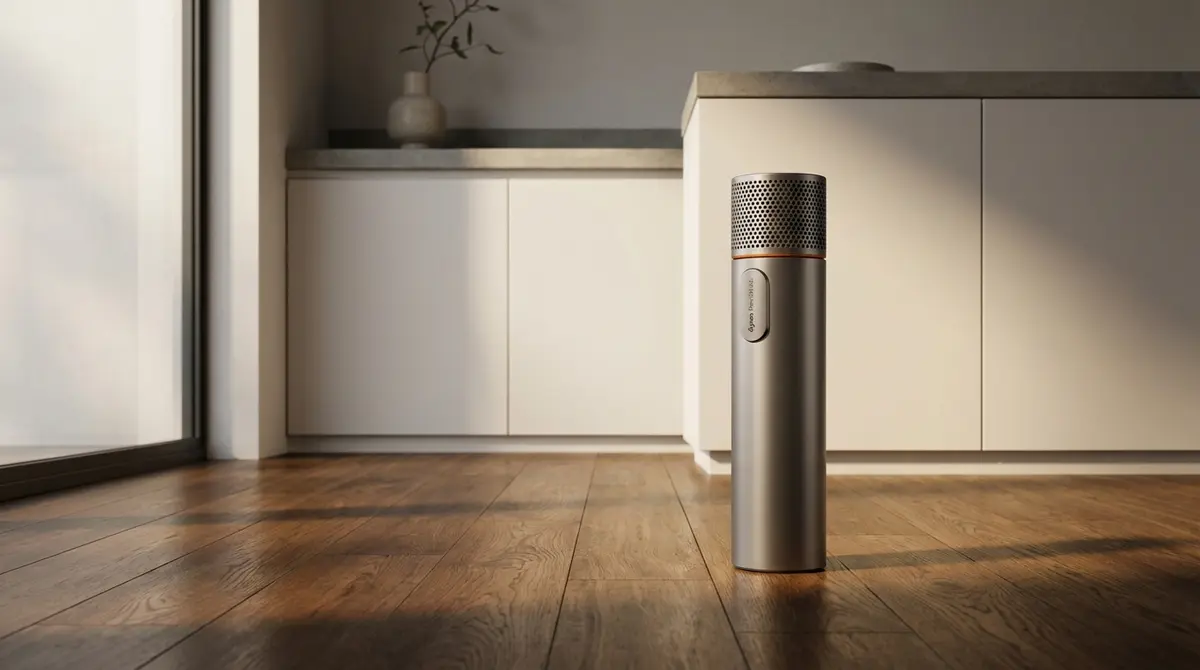
Following the release of the dry-only PencilVac in May 2025, the PencilWash adopts the same ultra-slim architecture but repurposes it for hydration and scrubbing. By housing the motor, battery, and electronics within a mere 1.5-inch diameter handle, Dyson has engineered a device that weighs just 4.9 lbs (2.2 kg). This technical walkthrough explores how Dyson managed to shrink a wet-cleaning system into a stick format and what compromises, if any, were made to achieve this footprint.
How does the PencilWash cleaning mechanism work?
To understand the PencilWash, one must first understand what it is not: it is not a vacuum. Unlike traditional wet-dry vacs that rely on high-velocity airflow to pull liquid into a tank, the PencilWash utilizes a mechanical extraction method derived from the company’s ‘Submarine’ cleaner head technology.
The device features a single motorized microfiber roller located in the cleaning head. The operational cycle involves three distinct stages: hydration, agitation, and extraction. First, the system dispenses clean water (or a low-foaming solution) from the 300ml onboard tank to saturate the roller. As the roller spins, the microfiber material agitates the floor surface to loosen stains and debris. Finally, a durable extraction plate squeezes the dirty water and debris from the roller, depositing it into a separate 360ml dirty water tank.
This absence of a suction motor is a critical design choice. It allows for a significantly smaller engine and battery profile, contributing to the device’s slender 1.5-inch handle. However, it also means the device is strictly for hard floors and lacks the versatility of hybrid wet-dry vacuums that can also handle dry dust collection via suction.
What are the battery life and coverage specifications?
Given the constraints of the 1.5-inch handle, battery density was a primary engineering challenge. The PencilWash is rated for a 30-minute runtime on a full charge. While this is lower than some of Dyson’s larger flagship vacuums, the efficiency of the mechanical roller system—which requires less energy than a vacuum suction motor—allows the device to cover approximately 100 square meters (roughly 1,076 square feet) per session.
The fluid dynamics of the machine are balanced to match this battery life. The 300ml clean water tank is designed to last through the majority of the battery’s runtime, though users with larger homes may need to refill the tank or empty the 360ml dirty water reservoir mid-clean. A notable ergonomic feature is the device’s ability to lay completely flat at a 170-degree angle. Because the water tanks and separation systems are engineered to prevent backflow, the PencilWash can slide under low furniture, addressing a common limitation of bulkier upright floor washers.
How does it compare to the WashG1 and PencilVac?
The PencilWash occupies a unique middle ground in Dyson’s 2026 portfolio. It sits between the dry-only PencilVac ($600) and the premium, dedicated wet cleaner, the WashG1 ($770). While the PencilVac focuses on dry debris with its ‘Fluffycones’ head, and the WashG1 offers a more robust, dual-roller wet cleaning experience for heavy-duty messes, the PencilWash targets the “daily maintenance” demographic.
At $349, the PencilWash is significantly cheaper than its siblings. This price point suggests Dyson is directly targeting the market segment currently dominated by manual mop pads (like Swiffer) and lower-end electric mops. By offering a powered, motorized solution that separates dirty water from clean water—unlike a traditional mop bucket—Dyson is attempting to bridge the gap between disposable convenience and premium automated cleaning.
Looking Ahead
The release of the PencilWash at $349 signals an aggressive shift in Dyson’s strategy, moving from exclusively high-margin luxury tools to volume-driving mid-range appliances. This poses a direct threat to competitors like Hizero and the premium tier of Procter & Gamble’s Swiffer line, as consumers can now access Dyson’s bionic mop technology for a price comparable to mid-range steam mops. However, the lack of suction limits its utility as a sole cleaning device; it is an additive tool, not a replacement for a dry vacuum. Senior industry analysts would likely view this as an ecosystem play—getting the Dyson motor into smaller homes and apartments where a $770 WashG1 is overkill, effectively locking younger demographics into the brand earlier in their lifecycle.
![Illustration related to Dyson PencilWash Specs and Price: $349 Wet Cleaner [Details]](https://bytewire.press/wp-content/uploads/bytewire-images/2026/02/dyson-pencilwash-specs-price-wet-cleaner-fdc02f6d61.webp)
![Diagram related to Dyson PencilWash Specs and Price: $349 Wet Cleaner [Details]](https://bytewire.press/wp-content/uploads/bytewire-images/2026/02/dyson-pencilwash-specs-price-wet-cleaner-3d3df3b3a5.webp)