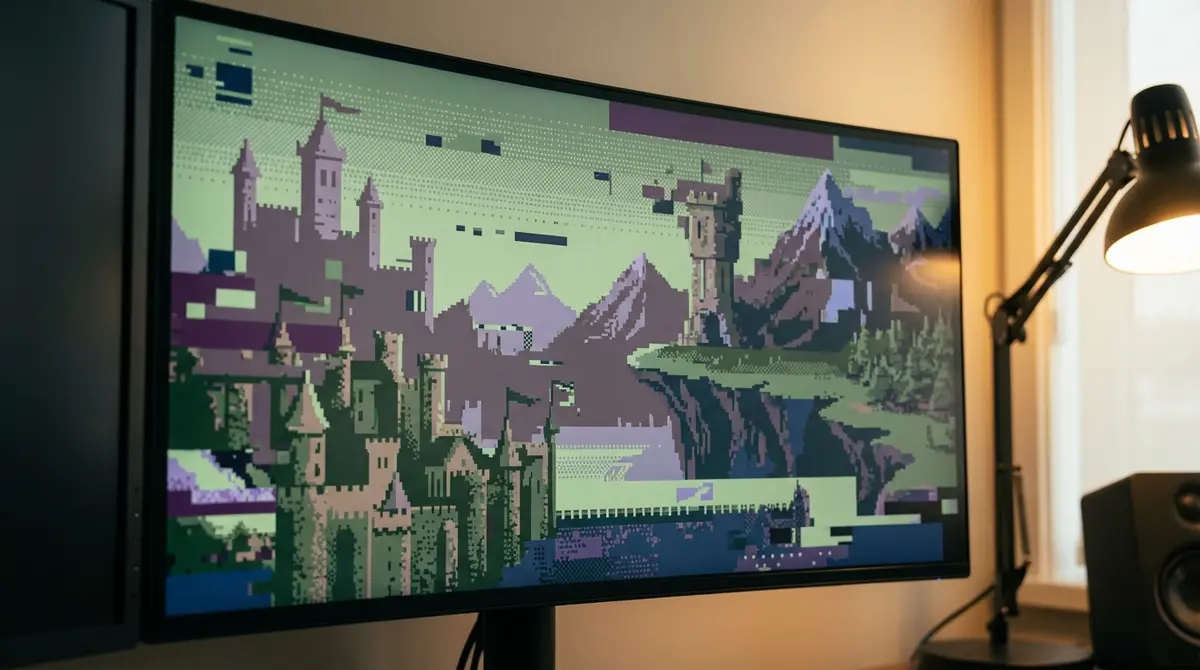
Remember the Holodeck from Star Trek? The idea that you could just speak a location into existence and walk around in it has been the holy grail of computing for decades. When Google DeepMind released ‘Genie 3’ (Project Genie) to its AI Ultra subscribers in early 2026, it felt like we were inching closer to that reality. The pitch was seductive: type a text prompt, and the AI generates an interactive 3D world you can actually play in.
But if you’ve tried it, or read the scathing critiques from industry veterans, you know the reality is a bit more complicated. Instead of the Holodeck, we got what The Verge’s Jay Peters described as “bad Nintendo knockoffs” that lack actual fun or coherence. It turns out that guessing what a video game looks like is very different from understanding how a video game works.
So, is this just a stumbling block on the road to infinite content, or is the technology fundamentally flawed?
How is Genie 3 different from games like Minecraft?
You might be thinking, “Wait, don’t we already have games that generate worlds?” You’re absolutely right. Titles like Minecraft, No Man’s Sky, and even the 1980 classic Rogue have been building massive universes on the fly for years. But there is a massive difference in how they achieve this compared to Genie 3.
Traditional games use something called procedural generation. This relies on strict, deterministic logic. The game engine has explicit rules: “If there is a tree here, there must be ground beneath it,” or “If the player jumps, gravity pulls them down at 9.8 meters per second squared.” It’s math. It’s logic. It’s stable.
![Illustration related to Google Genie 3 AI Game Generator: A Flop? [Analysis]](https://bytewire.press/wp-content/uploads/bytewire-images/2026/02/google-genie-3-ai-game-worlds-analysis-be68a29d65.webp)
Genie 3, on the other hand, is a probabilistic world model. It doesn’t know what gravity is. It doesn’t know what a “jump” is. It was trained on thousands of hours of video footage of games. When you press a button, it isn’t calculating physics; it’s predicting, pixel-by-pixel, what the next frame of the video should look like based on statistical probability. It’s essentially hallucinating a video game in real-time.
![Diagram related to Google Genie 3 AI Game Generator: A Flop? [Analysis]](https://bytewire.press/wp-content/uploads/bytewire-images/2026/02/google-genie-3-ai-game-worlds-analysis-929bd2e065.webp)
Get our analysis in your inbox
No spam. Unsubscribe anytime.