Have you ever looked at a corporate-issued laptop and immediately felt a wave of boredom? You aren’t alone. Business workstations are typically gray, bulky, and uninspired—tools designed for spreadsheets, not excitement. But every once in a while, a machine comes along that hides a sports car engine inside a sedan’s body.
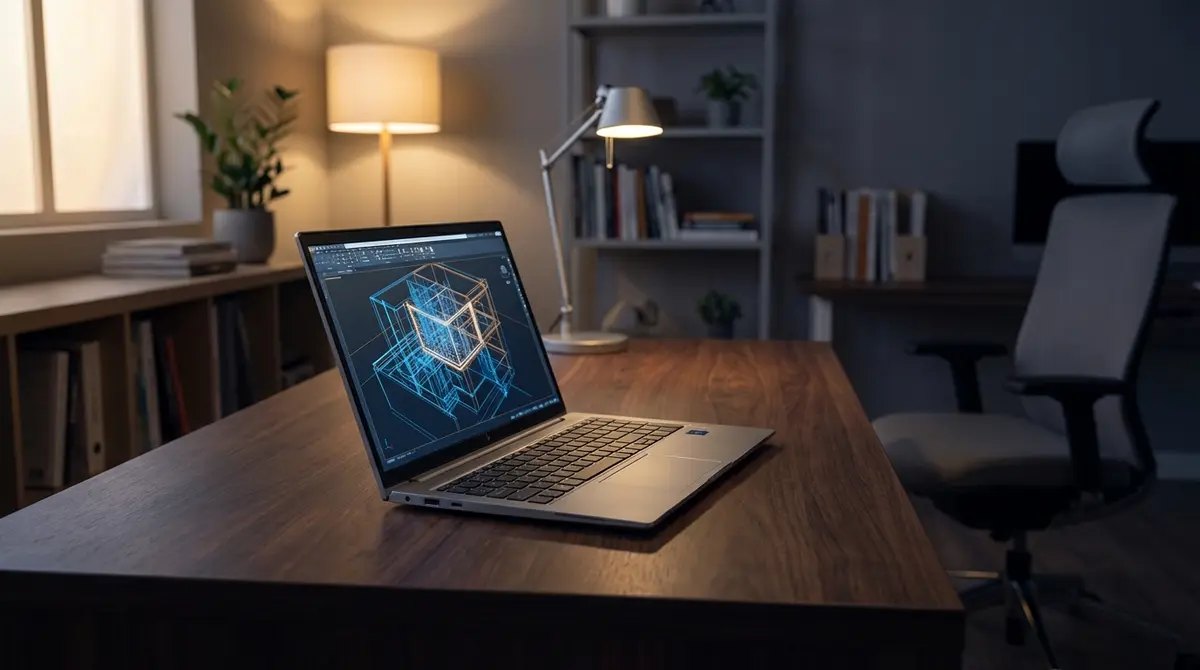
The HP ZBook Ultra G1a is exactly that kind of sleeper. At first glance, it looks like just another premium office computer. But under the hood, it represents a massive shift in mobile computing architecture. It is one of the first flagship devices to utilize AMD’s new "Strix Halo" (Ryzen AI Max 300 series) processors, a chip design that might just make entry-level discrete graphics cards obsolete.
What makes the Ryzen AI Max ‘Strix Halo’ chip so different?
For years, high-performance Windows laptops have followed a strict formula: a powerful CPU paired with a separate, discrete graphics card (usually from NVIDIA). While effective, this splits the memory. You have system RAM for the CPU and video RAM (VRAM) for the GPU. If you run out of VRAM while rendering a 3D scene or training an AI model, performance falls off a cliff.
AMD’s Strix Halo architecture flips this script. It utilizes a massive unified memory architecture, similar to the approach Apple took with its M-series Silicon. The CPU and the integrated GPU share the same pool of memory. In the case of the ZBook Ultra G1a, that pool can be as large as 128GB of LPDDR5x.
This is a game-changer for professionals. According to recent reviews, this setup allows for local AI workloads and complex 3D rendering tasks that would typically choke a standard laptop GPU with only 8GB or 16GB of VRAM. By eliminating the bottleneck of a discrete GPU, HP and AMD are creating a new class of "AI Workstation" that prioritizes memory capacity over raw brute force.
Can integrated graphics really replace an RTX 4060?
The skepticism is natural. "Integrated graphics" has historically been a polite term for "barely functional for gaming." However, the Radeon 8060S graphics engine inside the ZBook Ultra G1a features 40 Compute Units (CUs). To put that in perspective, research indicates this integrated chip delivers performance rivaling discrete NVIDIA RTX 4060 and even RTX 4070 Laptop GPUs.
This means you get the graphical horsepower needed for video editing and gaming without the heat, power draw, and motherboard space required for a separate graphics card. It allows the ZBook to maintain a relatively portable form factor—weighing in at around 3.5 lbs—while driving an optional 2.8K 120Hz OLED touchscreen.
Furthermore, HP has broken a long-standing barrier by including two Thunderbolt 4 ports. For years, Thunderbolt was largely an Intel exclusive in the laptop space. Seeing it here on an AMD platform signals that the premium connectivity gap between the two chipmakers has finally closed.
Who is this $4,000 laptop actually for?
Let’s be real about the price tag. High-end configurations of the ZBook Ultra G1a, specifically those with the Ryzen AI Max+ 395 and the full 128GB of RAM, are landing between $3,000 and around $8,250. This is not a budget machine.
It was, however, a harbinger of what high-end computing looked like in 2025. It joins a small but growing cohort of Strix Halo devices, including the Asus ROG Flow Z13 (2025) gaming tablet and the Framework Desktop small form-factor PC. These devices collectively demonstrate that this chip isn’t just for laptops; it’s versatile enough for tablets and desktops alike.
For data scientists, 3D artists, and AI developers, the value proposition is clear. You are paying for the ability to load massive datasets into memory that simply wouldn’t fit on a consumer-grade discrete GPU. It’s a specialized tool, but for the right user, it’s a bargain compared to enterprise server time.
Between the Lines
The release of the HP ZBook Ultra G1a validates the "super-APU" concept for the enterprise market, and that spells trouble for NVIDIA’s entry-to-mid-level mobile GPU business. If an integrated chip can match the performance of an RTX 4060 while offering vastly superior memory access for AI tasks, the justification for a dedicated graphics card in thin-and-light professional laptops evaporates. This is the first time the Windows ecosystem has offered a genuine architectural alternative to the MacBook Pro’s unified memory advantage, giving creative professionals a reason to look at PC hardware again without feeling like they are compromising on efficiency.
![Illustration related to HP ZBook Ultra G1a Review: Strix Halo Power [Analysis]](https://bytewire.press/wp-content/uploads/bytewire-images/2026/02/hp-zbook-ultra-g1a-review-amd-strix-halo-unified-memory-4003ccd299.webp)
![Diagram related to HP ZBook Ultra G1a Review: Strix Halo Power [Analysis]](https://bytewire.press/wp-content/uploads/bytewire-images/2026/02/hp-zbook-ultra-g1a-review-amd-strix-halo-unified-memory-34a09ad35e.webp)