If you thought the pivot from selling SMS APIs to synthesizing stars was a stretch, Jeff Lawson is here to prove you wrong. The former Twilio CEO has officially re-entered the arena, but this time he isn’t disrupting the telecom industry—he’s aiming for the electric grid.
Lawson’s new venture, Inertia Enterprises, has just secured a massive $450 million Series A funding round led by Bessemer Venture Partners. The goal? To commercialize inertial confinement fusion, the specific type of nuclear reaction that made headlines in 2022 for finally achieving net energy gain.
This isn’t just a software founder throwing money at a hobby. Lawson has teamed up with legitimate heavyweights in the physics world to build what they call “Thunderwall,” a laser system designed to turn scientific theory into continuous power. With participation from Alphabet’s GV and other top-tier firms, Inertia is signaling that the race for commercial fusion is moving from “if” to “when.”
Who is behind Inertia Enterprises and why does it matter?
The most striking aspect of this announcement is the founding team’s composition. It reads like a carefully curated mix of Silicon Valley hustle and Nobel-level intellect.
First, you have Jeff Lawson, the software architect who scaled Twilio into a communications giant. He brings the operational and fundraising muscle required to navigate the “valley of death” that kills most hard-tech startups. But the scientific credibility comes from his co-founders:
Dr. Andrea ‘Annie’ Kritcher: A former lead physicist at Lawrence Livermore National Laboratory (LLNL), Kritcher was instrumental in the National Ignition Facility (NIF) experiments that achieved the world’s first fusion ignition.
Mike Dunne: A veteran fusion plant designer formerly of SLAC and Stanford, tasked with turning the physics into a working machine.
Byron Deeter of Bessemer Venture Partners noted that Inertia represents the firm’s “first investment into the direct fusion market,” specifically because the startup presented a clear roadmap to commercial energy rather than just experimental science. The round also saw backing from Threshold Ventures, Long Journey Ventures, and IQT, among others.
How does Inertia’s technology differ from other fusion startups?
If you’ve followed the fusion space, you might be familiar with “tokamaks”—those donut-shaped reactors that use powerful magnets to contain superheated plasma. While tokamaks represent one major branch of fusion research, Inertia Enterprises, like Longview Fusion Energy Systems, is betting on lasers.
The company is capitalizing on the breakthrough at the National Ignition Facility (NIF) in December 2022. NIF used 192 massive lasers to blast a tiny pellet of fuel, compressing it until it fused and released more energy than the lasers delivered. It proved the physics works. However, NIF was built for science, not power; its lasers could only fire once every few hours or days.
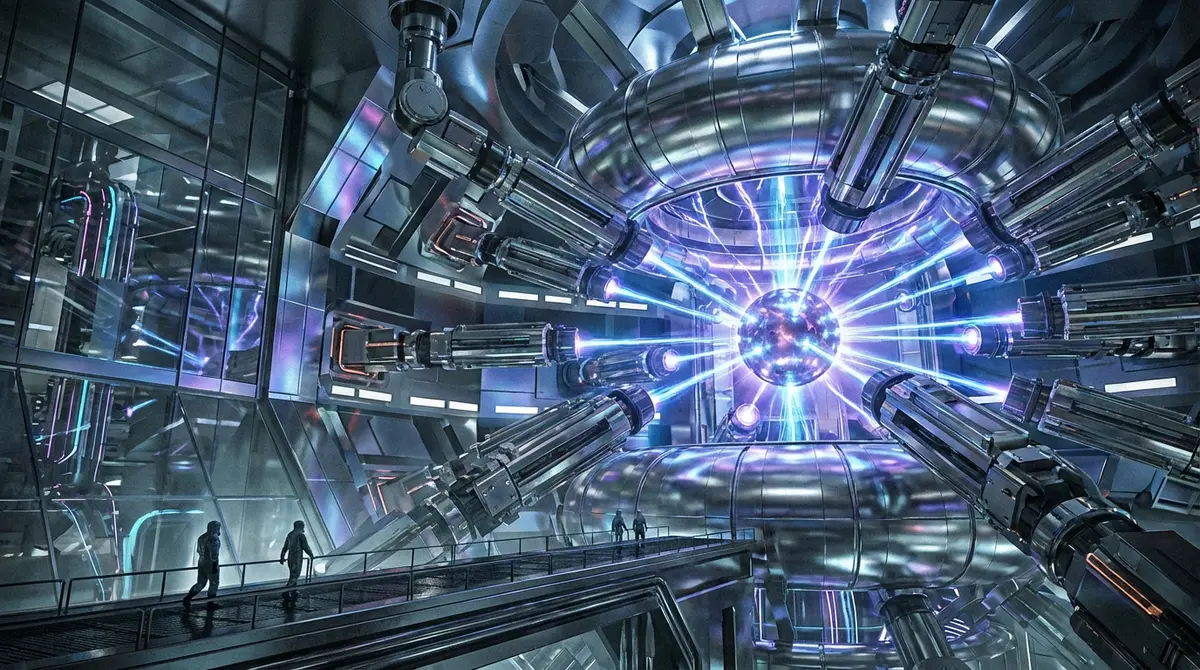
Inertia’s plan is to industrialize this process. They are building “Thunderwall,” a system utilizing modern, high-efficiency diode-pumped lasers capable of firing ten times per second. This high-repetition rate is the key to generating the continuous baseload power required for a commercial plant. The funding will also support the creation of a manufacturing line for the fuel targets—the tiny capsules that the lasers obliterate to create energy.
Why is there a sudden surge in fusion funding right now?
Inertia’s $450 million raise is huge, but it isn’t happening in a vacuum. It follows closely on the heels of competitor Pacific Fusion, which raised a staggering $900 million Series A in November 2024. This was followed by Commonwealth Fusion Systems securing $863M in August 2025. Other players like Helion Energy have raised billions, and Longview Fusion Energy Systems recently secured Department of Energy grants.
So, why the sudden rush? Two words: AI demand.
Data centers powering artificial intelligence models are consuming electricity at an unprecedented rate. Tech giants are scrambling for clean, consistent power sources that solar and wind (which are intermittent) struggle to provide on their own. As reported by Axios, energy demand for AI is a primary driver for this renewed interest in fusion.
Investors like GV (Alphabet’s venture arm) are likely looking at fusion not just as a climate solution, but as a survival mechanism for the massive compute infrastructure being built today. Lawson himself has stated that the plan is to deliver “the first gigawatt, utility-scale fusion power plant to the grid,” with construction targeted to begin by 2030.
What To Watch
The entry of Jeff Lawson into the fusion space signals a critical shift in the industry: fusion is graduating from a physics problem to a manufacturing problem. The science of inertial confinement is proven (thanks to NIF); the challenge now is building the supply chain to manufacture fuel pellets and high-rep lasers at scale. Watch closely how Inertia manages its burn rate against its timeline—building hardware is infinitely more capital-intensive than shipping code. If Inertia or Longview can demonstrate a working high-repetition laser system within the next 24 months, the magnetic confinement crowd (tokamaks) may suddenly find themselves fighting for relevance in the next decade of energy infrastructure.
![Illustration related to Jeff Lawson's Inertia Enterprises: $450M for Fusion [Report]](https://bytewire.press/wp-content/uploads/bytewire-images/2026/02/inertia-enterprises-series-a-laser-fusion-jeff-lawson-5060dbba8d.webp)
![Diagram related to Jeff Lawson's Inertia Enterprises: $450M for Fusion [Report]](https://bytewire.press/wp-content/uploads/bytewire-images/2026/02/inertia-enterprises-series-a-laser-fusion-jeff-lawson-9745b29851.webp)