If you ask most people to picture Mars, they imagine a frozen, desolate desert where water only exists as ice caps or perhaps, billions of years ago, as fleeting puddles. But a new discovery by NASA’s Perseverance rover is turning that icy narrative on its head. It turns out, ancient Mars might have looked a lot more like a rainy tropical island than a cold Antarctic wasteland.
Researchers from Purdue University, working with the Perseverance team, have identified a specific type of rock in Jezero Crater that changes the game: kaolinite. These aren’t just any rocks; they are aluminum-rich clay pebbles that tell a story of intense, persistent rainfall. This discovery offers the strongest evidence yet that the Red Planet wasn’t just “wet” in spurts—it was warm, stable, and lashed by rain for millions of years.
What did the Perseverance rover actually find?
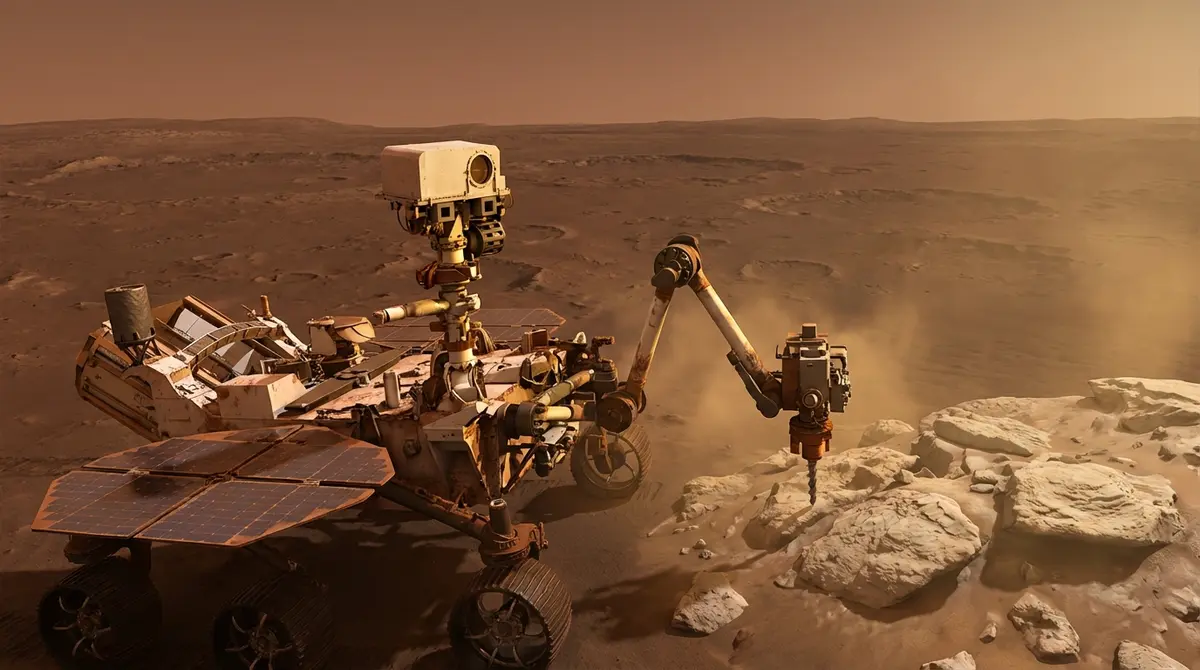
While exploring Jezero Crater, Perseverance’s SuperCam and Mastcam-Z instruments zeroed in on what geologists call “float rocks.” These are loose boulders and pebbles that didn’t form right where they were found; they were transported there, likely tumbling down from the crater rim or washed in from beyond.
When the team analyzed the chemical makeup of these rocks, the results were striking. The rocks were heavily depleted in iron and magnesium—two elements usually abundant in Martian volcanic rock—but they were enriched in aluminum and titanium.
According to Adrian Broz, the lead author of the study from Purdue University, this specific chemical signature is a smoking gun. “So when you see kaolinite on a place like Mars… it tells us that there was once a lot more water than there is today,” Broz noted. The chemical alteration implies that water didn’t just sit on these rocks; it flushed through them, stripping away the heavy metals and leaving the aluminum clays behind.
Why does kaolinite prove a ‘warm and wet’ climate?
For decades, planetary scientists have been locked in a debate: Was ancient Mars “warm and wet” with oceans and rain, or “cold and icy” with only transient meltwater? The presence of kaolinite heavily tips the scales toward the former.
On Earth, kaolinite forms in tropical environments where intense rainfall leaches nutrients out of the bedrock. It requires a massive amount of water throughput to create. You don’t get this kind of mineralogy from a brief flood or a few years of melting ice. You need a hydrological cycle that is active and aggressive.
“You need so much water that we think these could be evidence of an ancient warmer and wetter climate where there was rain falling for millions of years,” explained Briony Horgan, a co-author and Perseverance Mission Planner at Purdue. This rules out the idea that the water was purely hydrothermal (heated from below) because the chemistry matches downward leaching from rain, not upward alteration from steam.
How does this impact the future of Mars exploration?
This discovery drastically increases the scientific value of the samples Perseverance is currently caching. We now have potential evidence of a habitable environment that lasted long enough for life to potentially gain a foothold. However, the timing of this discovery is bittersweet.
Just as the scientific case for a Mars Sample Return (MSR) mission becomes undeniable, the logistical path is crumbling. As of early 2026, the US Congress has effectively defunded the current architecture of NASA’s MSR program due to ballooning costs. Simultaneously, Elon Musk announced in February that SpaceX is delaying its Mars colonization ambitions to prioritize a “Moon City,” shifting the commercial sector’s immediate focus to the lunar surface.
This leaves the rocks found by Broz and Horgan in a precarious position. They are some of the most valuable geological samples ever identified, sitting in titanium tubes on another planet, with no confirmed ride home. Meanwhile, reports suggest China’s Tianwen-3 mission is pressing forward, potentially positioning them to return the first Martian samples while NASA’s cache waits in limbo.
Between the Lines
The irony here is stark. Scientifically, we have just found the “Holy Grail” of Martian habitability—proof of a stable, long-term water cycle essential for life. Yet, politically and commercially, interest in Mars is waning in favor of the Moon. The winners in this scenario may ultimately be the Chinese space program, which could capitalize on American hesitation to snatch the sample-return milestone. For the US scientific community, this is a wake-up call: having the best rover on the ground means nothing if the budget evaporates before the finish line.
![Illustration related to Mars Was Tropical: Kaolinite Pebbles Prove Rain [Study]](https://bytewire.press/wp-content/uploads/bytewire-images/2026/02/mars-perseverance-kaolinite-discovery-warm-wet-climate-85d0ddb2c6.webp)
![Diagram related to Mars Was Tropical: Kaolinite Pebbles Prove Rain [Study]](https://bytewire.press/wp-content/uploads/bytewire-images/2026/02/mars-perseverance-kaolinite-discovery-warm-wet-climate-304cd9b06d.webp)