just when it seemed like all systems were go for a historic return to the moon, NASA is tapping the brakes. The Artemis II mission, slated to be the first crewed lunar flyby in over half a century, has officially lost its March 6, 2026, launch window. If you have been following the saga of the Space Launch System (SLS), this might feel like a bit of déjà vu.
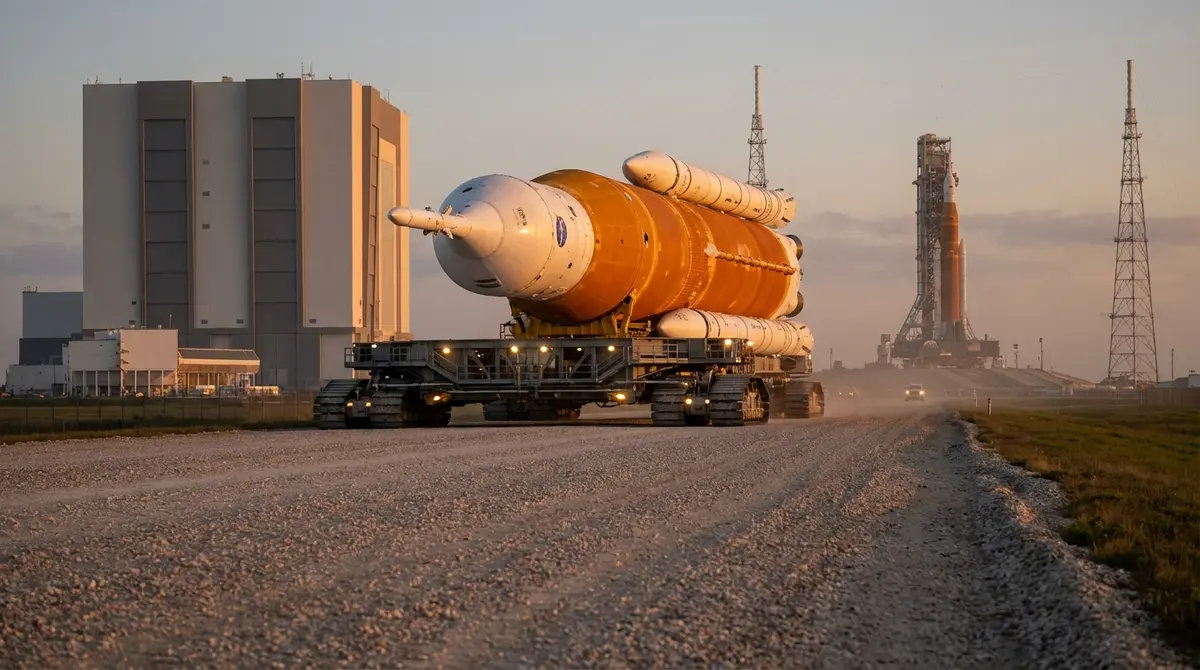
Despite completing a successful Wet Dress Rehearsal on February 19, engineers detected a critical anomaly overnight that has forced the agency to make a tough call: the rocket is heading back to the garage. As of February 21, preparations are underway to roll the massive vehicle back to the Vehicle Assembly Building (VAB), delaying the mission until at least April.
So, what exactly went wrong after such a promising rehearsal? Let’s break down the technical gremlins and what this means for the four astronauts waiting for their ride.
What caused the sudden Artemis II rollback?
Spaceflight is often a battle against the smallest of details, and in this case, the culprit is helium. According to NASA, the decision to roll back stems from an interruption in helium flow detected within the Interim Cryogenic Propulsion Stage (ICPS).
The ICPS is a critical component of the rocket stack. It is essentially a modified Delta IV upper stage manufactured by United Launch Alliance, and it is responsible for the trans-lunar injection burn—the massive push that sends the Orion spacecraft out of Earth’s orbit and toward the moon.
Helium might sound like a minor commodity, but in rocketry, it is non-negotiable. It is used to purge engines and pressurize fuel tanks to ensure propellants flow correctly during flight. While the system functioned perfectly during the recent Wet Dress Rehearsal, the flow interruption appeared shortly after, raising red flags that engineers could not ignore. Without reliable helium flow, the engines cannot safely fire or shut down, posing an unacceptable risk to the crew.
Why can’t NASA fix this on the launchpad?
You might wonder why engineers can’t just send a technician up the tower to tighten a valve. Unfortunately, the SLS is not that simple. Jared Isaacman, who took over as NASA Administrator in December 2025, was clear about the logistical constraints.
Isaacman confirmed that regardless of the specific component failure, accessing and remediating the issue "can only be performed in the VAB." The mobile launcher and the pad infrastructure simply do not provide the necessary access points or environmental controls to open up the ICPS and perform deep internal repairs. The rocket has to be disconnected, secured, and slowly crawled back to the hangar to allow teams to physically reach the fault.
How does this impact the launch timeline?
The immediate consequence is the loss of the March launch opportunity. NASA had been targeting March 6, 2026, but the rollback process alone eats up days of valuable time. The agency has confirmed that the earliest possible launch window is now April 2026.
This delay adds to a timeline that has already stretched significantly from its original 2024 target. For the crew—Reid Wiseman, Victor Glover, Christina Koch, and Jeremy Hansen—it means another month of waiting. This setback echoes the teething issues faced during the uncrewed Artemis I campaign in 2022, which also saw multiple rollbacks to the VAB to address technical leaks and valve issues.
What are the market implications for Boeing?
While the delay is frustrating for space enthusiasts, it has tangible financial impacts for the contractors involved. Boeing, the prime contractor for the SLS Core Stage, is facing a negative catalyst. Analysts note that this delay pushes approximately $4 billion in revenue recognition associated with the launch into the next fiscal quarter or potentially the next fiscal year.
While Boeing’s stock is currently viewed as "fairly" valued by the market, these repeated delays continue to weigh on investor sentiment regarding its Defense, Space & Security division. Every day the rocket sits on the ground requires a "standing army" of engineers and support staff, driving up costs and delaying the financial milestones that the company relies on.
Why It Matters
This delay is the first major programmatic test for Jared Isaacman since his confirmation as NASA Administrator, forcing him to balance intense public anticipation with the absolute necessity of crew safety. It highlights a persistent vulnerability in the Artemis architecture: the reliance on legacy hardware like the ICPS, where a single valve issue can scrub a multi-billion dollar launch campaign. For the industry, it reinforces the stark contrast between the slow, methodical cadence of government-led programs and the rapid iteration of commercial competitors. Ultimately, while safety must be the priority, every rollback erodes political capital and public patience for a program that is already years behind schedule.
![Illustration related to Artemis II Delayed to April 2026: Helium Issue [Update]](https://bytewire.press/wp-content/uploads/bytewire-images/2026/02/artemis-ii-delayed-april-2026-helium-issue-8f2cc31d6a.webp)
![Diagram related to Artemis II Delayed to April 2026: Helium Issue [Update]](https://bytewire.press/wp-content/uploads/bytewire-images/2026/02/artemis-ii-delayed-april-2026-helium-issue-fb907cd932.webp)