General Tech

Ricursive Intelligence Series A: $335M at $4B Value

Imagine launching a company and hitting a $4 billion valuation before you have barely had time to print business cards. That sounds like a fever dream from the dot-com bubble, but it is exactly what just happened with Ricursive Intelligence. Just two months after their public launch in December 2025, this startup has secured a massive war chest to solve one of the biggest bottlenecks in tech.

According to recent reports, Ricursive has raised a $300M Series A round led by Lightspeed Venture Partners. When you tally up their total funding, it sits at $335M. What is driving this frenzy? It isn’t just hype; it is the pedigree of the founders and a specific technology that could rewrite how computers are built.

Who are the minds behind Ricursive Intelligence?

If you follow the deep weeds of AI research, the names Anna Goldie and Azalia Mirhoseini might ring a bell. They are former Google researchers who pioneered ‘AlphaChip,’ a revolutionary method that used reinforcement learning to design chip layouts. This wasn’t just a theoretical paper; AlphaChip was actually used to design Google’s powerful Tensor Processing Units (TPUs).

The industry took notice. According to TechCrunch, the reason VCs were lining up around the block wasn’t just the idea, but the team. Everyone in the AI world reportedly tried to hire them. Instead of joining another giant, they struck out on their own. Now, backed by heavyweights like Sequoia, DST Global, and even Nvidia’s NVentures, they are scaling that vision. As CEO Anna Goldie put it, their mission is to "radically accelerate chip design and, ultimately, to use AI to design its own silicon substrate."
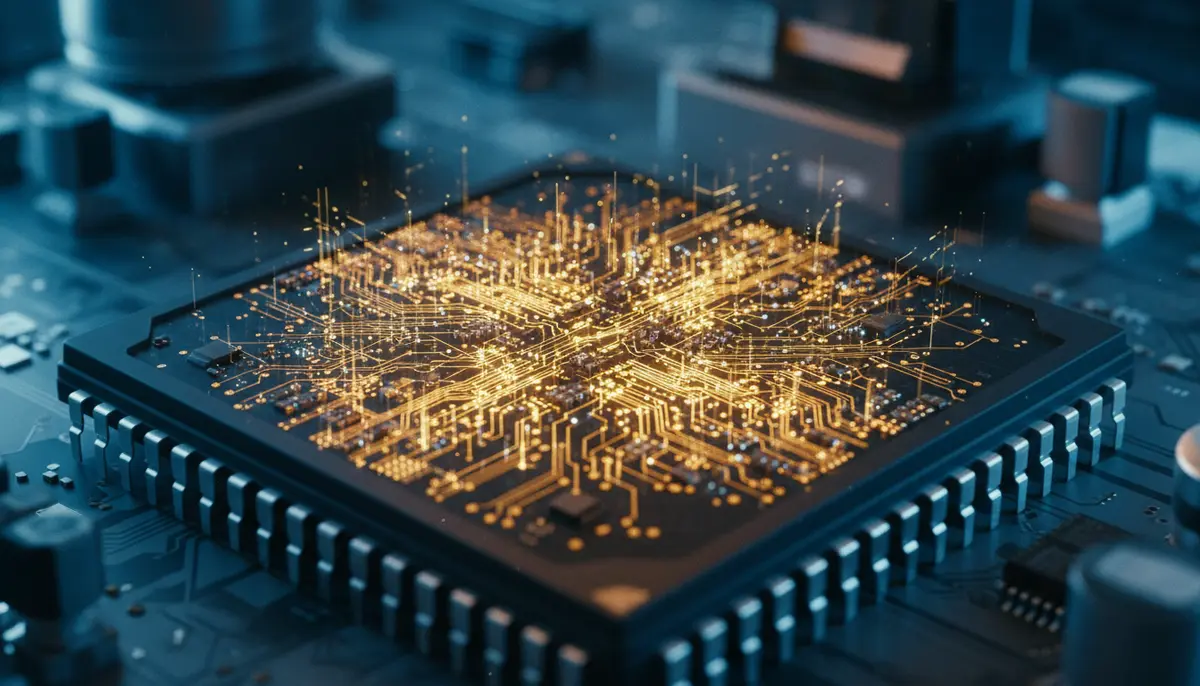
Illustration related to Ricursive Intelligence Series A: $335M at $4B Value

Why is AI-designed hardware the new gold rush?

You might be asking: why do we need AI to design chips? Can’t humans just keep doing it? The problem is complexity. As AI models get smarter, they require exponentially more powerful hardware. Designing these chips by hand is becoming slower and incredibly expensive. It is a classic bottleneck.

Ricursive is betting on ‘self-improving’ AI hardware. The thesis is that AI can autonomously design semiconductor architectures faster and better than human engineers using traditional Electronic Design Automation (EDA) tools. Guru Chahal, a partner at Lightspeed, noted that Ricursive is addressing the "gap between AI advancement and semiconductor capability." If they succeed, we aren’t just talking about slightly faster phones; we are talking about the hardware infrastructure necessary for the next generation of AI.

Is there a confusing battle of names heating up?

Here is where things get a little tricky for casual observers. If you search for "Recursive" (with an ‘e’) and "Ricursive" (with an ‘i’), you are going to find two very different companies fighting for very similar turf. While Goldie and Mirhoseini run Ricursive Intelligence, there is a rival company called Recursive, founded by Richard Socher.

To make matters more intense, reports suggest Socher’s Recursive is also closing a round at a matching $4B valuation. Add to that Unconventional AI, founded by Naveen Rao, which recently raised $475M at a $4.5B valuation for similar technology, and you have a high-stakes race. It is a crowded, confusing, and incredibly expensive battle to define the future of ‘intelligent substrate’ technology.

Diagram related to Ricursive Intelligence Series A: $335M at $4B Value

What This Really Means

This massive capital injection signals a decisive pivot in the AI economy. For the last three years, the money has been chasing foundation models (like GPT or Gemini). Now, smart money is moving down the stack to the physical layer. This is bad news for traditional EDA toolmakers, who risk being disrupted by autonomous design agents. However, it is a potential win for the entire AI ecosystem; if Ricursive succeeds, the cost of compute could drop drastically while performance skyrockets, effectively uncapping the limits currently slowing down AI progress. The participation of Nvidia’s NVentures is particularly telling—even the king of AI chips knows that the future of design might not be human.

Get our analysis in your inbox

No spam. Unsubscribe anytime.

Share this article

Leave a Comment