Have you ever watched a modern car factory in action and wondered what happens to all the data being collected? Every camera, every sensor, and every robotic arm movement is a literal goldmine of information. Imagine trying to teach a machine to pick up a delicate wiring harness or adapt to a misaligned bolt. That requires massive amounts of real-world training data. Now, Rivian’s CEO RJ Scaringe is tapping into that exact goldmine with a massive new venture.
His latest creation, a spin-out called Mind Robotics, just secured a staggering $500 million Series A funding round. Founded in 2025, the startup has quickly become a heavyweight in the emerging field of physical AI, bringing its total valuation to a jaw-dropping $2 billion.
How is Mind Robotics leveraging Rivian’s factory data?
You might be wondering how a brand-new startup can immediately start building advanced industrial robots. The secret weapon is Rivian itself. Rivian isn’t just a passive partner; the automaker is a major shareholder and serves as the ultimate real-world laboratory.
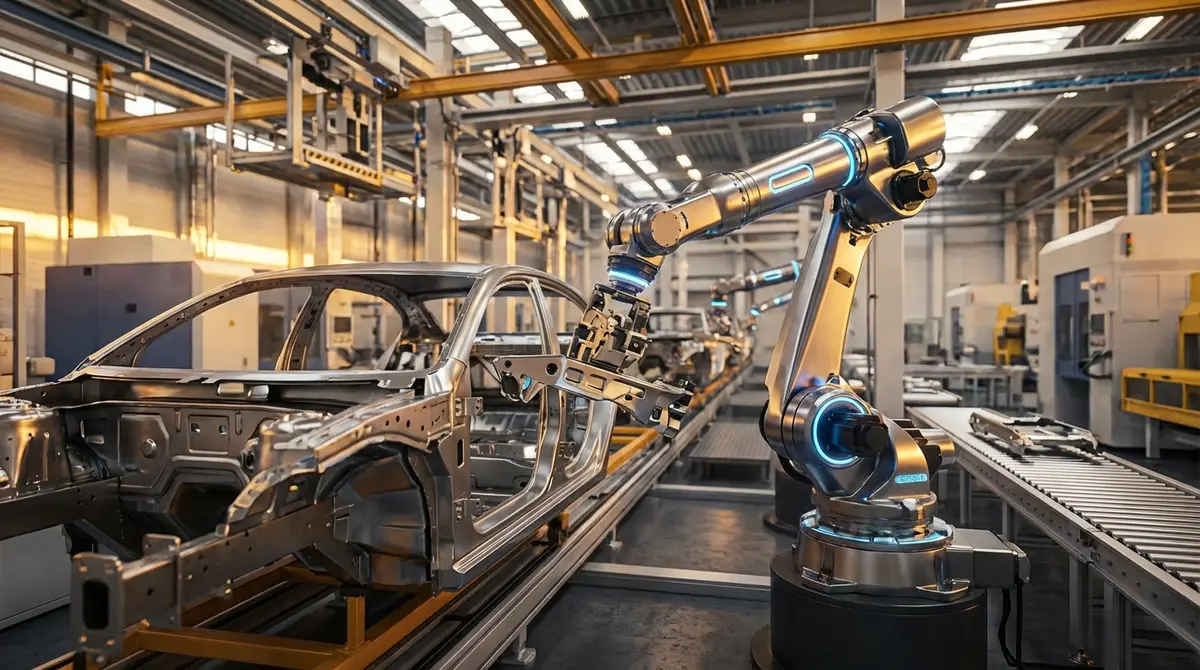
According to reports, Rivian is providing Mind Robotics with a robotics data flywheel. By granting the startup access to its factory cameras and active production lines, Mind Robotics can train its AI models on actual manufacturing scenarios. The ultimate goal is to build AI-enabled robots capable of human-like dexterity, physical reasoning, and real-time adaptation. Instead of programming a robot to repeat one rigid motion, these machines will learn to adapt to their physical environment to complete complex industrial tasks.
Why did RJ Scaringe spin this out instead of keeping it in-house?
It’s a fair question: if these robots are going to make Rivian’s factories more efficient, why not keep the project entirely under the Rivian umbrella? The answer comes down to capital and focus. Mind Robotics is actually Rivian’s second major spin-out of 2025, following the launch of ALSO Inc., a micromobility startup focused on compact electric vehicles like e-bikes.
By creating independent entities, Rivian can monetize its deep engineering expertise while aggressively attracting external venture capital. And the strategy is clearly working. This $500 million Series A was co-led by heavyweights Accel and Andreessen Horowitz (a16z), following a previously secured $115 million in seed funding led by Eclipse Ventures. Accel’s Sameer Gandhi is also joining the startup’s board. This structure allows Rivian to accelerate expensive physical AI research using VC money, while still directly benefiting from the resulting manufacturing efficiencies on its own assembly lines.
As Scaringe himself explained, “As AI enters the physical world, we believe the largest, at-scale application for advanced robotics will be across the industrial sector… We’re building robots that will perform real tasks, in real plants, at real scale.”
What does this mean for the future of physical AI in manufacturing?
This massive funding round signals profound venture capital confidence in the industrial automation sector. We are witnessing a growing industry trend where proprietary manufacturing data is being weaponized to solve global industrial labor shortages and dramatically improve factory efficiency.
Rivian has already been aggressively expanding its physical AI capabilities. The automaker recently revealed that it developed a custom in-house processor capable of 800 TOPS (Tera Operations Per Second) specifically for Level 4 autonomous driving. That same obsession with end-to-end hardware and AI integration is now being funneled into Mind Robotics.
Sarah Wang, General Partner at a16z, highlighted why investors are betting so heavily on this specific team. “RJ is one of the very few founders who have built and scaled a vertically integrated hardware company,” Wang noted. “That kind of end-to-end systems leadership is precisely what it takes to build a generational robotics company.”
The Bigger Picture
Mind Robotics isn’t just building a factory helper; it represents a brilliant financial maneuver by Rivian to offload massive R&D costs onto venture capitalists while keeping the operational upside. Legacy automakers and pure-play robotics startups stand to lose the most here, as they simply do not possess the tightly integrated, real-world data flywheel that an active EV production line provides. Ultimately, this $2 billion valuation proves that the next major frontier of artificial intelligence isn’t generating text or images, but fundamentally rewriting the economics of physical labor and industrial manufacturing.
![Illustration related to Rivian Mind Robotics Spin Out: $500M AI Funding [Analysis]](https://bytewire.press/wp-content/uploads/bytewire-images/2026/03/rivian-mind-robotics-500m-spin-out-ai-94445faf63.webp)
![Diagram related to Rivian Mind Robotics Spin Out: $500M AI Funding [Analysis]](https://bytewire.press/wp-content/uploads/bytewire-images/2026/03/rivian-mind-robotics-500m-spin-out-ai-703f11ee49.webp)