For decades, astronomers have stared at a frustrating blank spot on our cosmic map. We call it the "Kuiper Cliff." It marks the apparent edge of the Kuiper Belt, that donut-shaped ring of icy debris extending from Neptune out to about 50 astronomical units (AU). Past that point, the population of space rocks seemed to simply vanish. It was as if the solar system just… ended.
But the map is changing. With the Vera C. Rubin Observatory officially kicking off its 10-year Legacy Survey of Space and Time (LSST) in early 2026, and complementary data arriving from the Subaru Telescope, that hard edge is blurring. We are now seeing evidence that the solar system doesn’t just stop at the cliff—it might actually extend into a massive, previously invisible structure that rivals the planetary systems we observe around other stars.
What is the mystery of the ‘Kuiper Cliff’?
To understand why recent findings are so significant, you have to look at what we thought we knew. The Kuiper Belt is effectively the solar system’s attic, filled with icy remnants from the formation of the planets. It stretches from Neptune’s orbit (30 AU) out to 50 AU. For years, models suggested the density of objects should gradually taper off. Instead, observations showed a sharp drop-off—a cliff—at 50 AU.
Astronomers have long debated whether this cliff was real or just an illusion caused by the limitations of our technology. Were the objects actually missing, or were they just too small and faint for 20th-century telescopes to see? The consensus was leaning toward a physical edge, perhaps caused by a hidden planet shepherding the debris or a quirk of stellar evolution.
However, the narrative is flipping. According to recent reports, the Subaru Telescope has identified a population of objects beyond this 55 AU boundary. This suggests the existence of a "second" Kuiper Belt or a complex extension of the first, fundamentally altering our understanding of the solar system’s architecture.
How is the Vera C. Rubin Observatory changing the game?
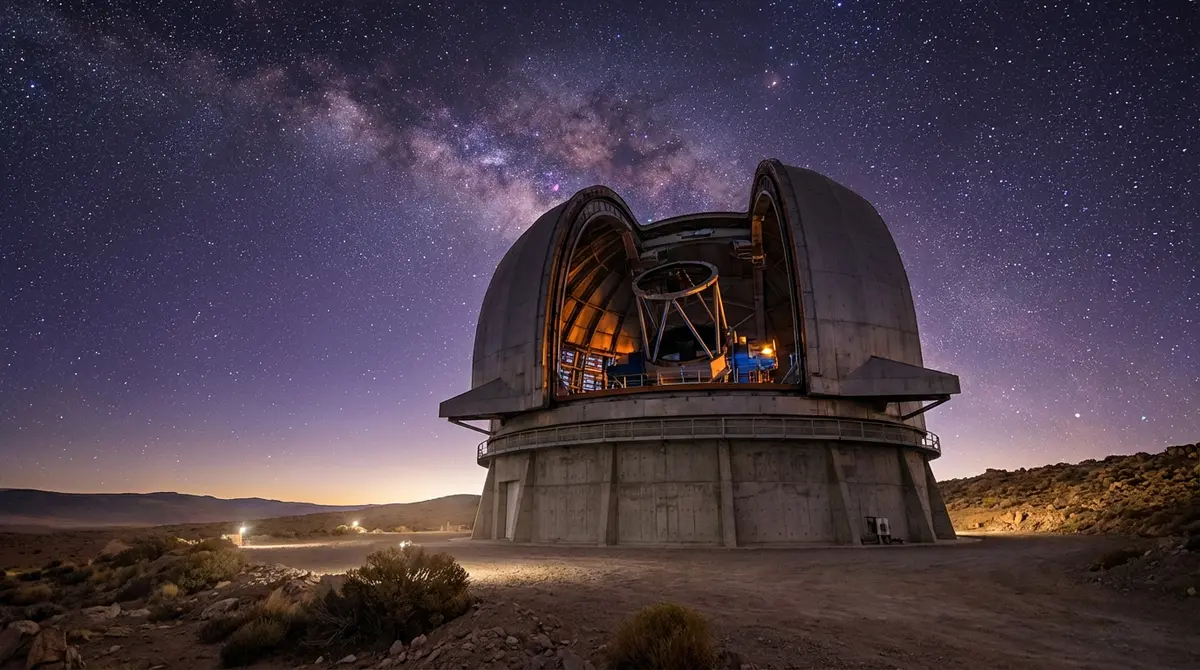
Located in Chile, the Vera C. Rubin Observatory is an engineering marvel designed specifically to solve mysteries like the Kuiper Cliff. It houses the world’s largest digital camera, capable of capturing the southern sky with unprecedented depth and speed. While previous surveys might have taken years to cover small patches of sky, Rubin is designed to scan the entire visible sky every few nights.
The observatory began its survey operations in early 2026, and the results were immediate. In January 2026, even before the full survey ramped up, pre-survey data revealed 19 new super- and ultra-fast rotating asteroids. This seemingly small discovery served as a massive proof-of-concept: Rubin can detect faint, transient objects that older telescopes simply missed.
This leap in sensitivity is exactly what is needed to peer into the darkness beyond 50 AU. By detecting smaller, fainter bodies, Rubin is filling in the blanks, proving that the "empty" space beyond the cliff might be teeming with activity.
Is our solar system actually similar to others?
One of the most intriguing aspects of this new research is what it says about our place in the galaxy. Planetary scientists have often viewed our solar system as somewhat unique compared to the exoplanetary systems we observe, many of which have vast debris disks extending far from their host stars.
Fumi Yoshida, a key researcher from the Planetary Exploration Research Center at the Chiba Institute of Technology, notes the implications of finding a second belt. "If this is confirmed, it would be a major discovery," Yoshida said, "The primordial solar nebula was much larger than previously thought, and this may have implications for studying the planet formation process in our Solar System."
This aligns with findings from late 2025, where the Subaru Telescope’s OASIS survey successfully combined ground-based imaging with space-based data to find hidden exoplanets. The techniques validated there are now being turned inward, helping us realize that our own backyard is much larger than we assumed.
What does this mean for the New Horizons mission?
While Rubin scans from the ground, NASA’s New Horizons spacecraft is actually out there, currently traveling beyond 60 AU. The probe, famous for its Pluto flyby, is deep in the territory that astronomers are trying to map.
The synergy here is critical. While Rubin’s wide-field data is planned to be used for hunting potential flyby targets for New Horizons, with specific deep-drilling surveys scheduled to begin in Summer 2026, Subaru Telescope data is currently the primary source. Finding an object close enough to the spacecraft’s trajectory is a needle-in-a-haystack problem, but with Rubin’s sensitivity, the chances of identifying a target in this newly discovered "second belt" have increased significantly.
Why It Matters
The discovery of a potential second Kuiper Belt isn’t just an academic win for astronomy; it represents a fundamental shift in the data economy of space exploration. We are moving from an era of scarcity—where a single image was a headline—to an era of petabyte-scale data processing that demands advanced AI and machine learning infrastructure just to make sense of the noise. This benefits the tech sector developing high-throughput data pipelines, but it poses a challenge for traditional institutions that must now adapt to "industrial-scale" science. Ultimately, erasing the "Kuiper Cliff" forces us to admit that our maps were incomplete not because the universe was empty, but because our vision was limited.
![Illustration related to Second Kuiper Belt Found? Rubin Data vs The Cliff [Analysis]](https://bytewire.press/wp-content/uploads/bytewire-images/2026/02/rubin-observatory-second-kuiper-belt-evidence-d479fbe45e.webp)
![Diagram related to Second Kuiper Belt Found? Rubin Data vs The Cliff [Analysis]](https://bytewire.press/wp-content/uploads/bytewire-images/2026/02/rubin-observatory-second-kuiper-belt-evidence-c143c79079.webp)