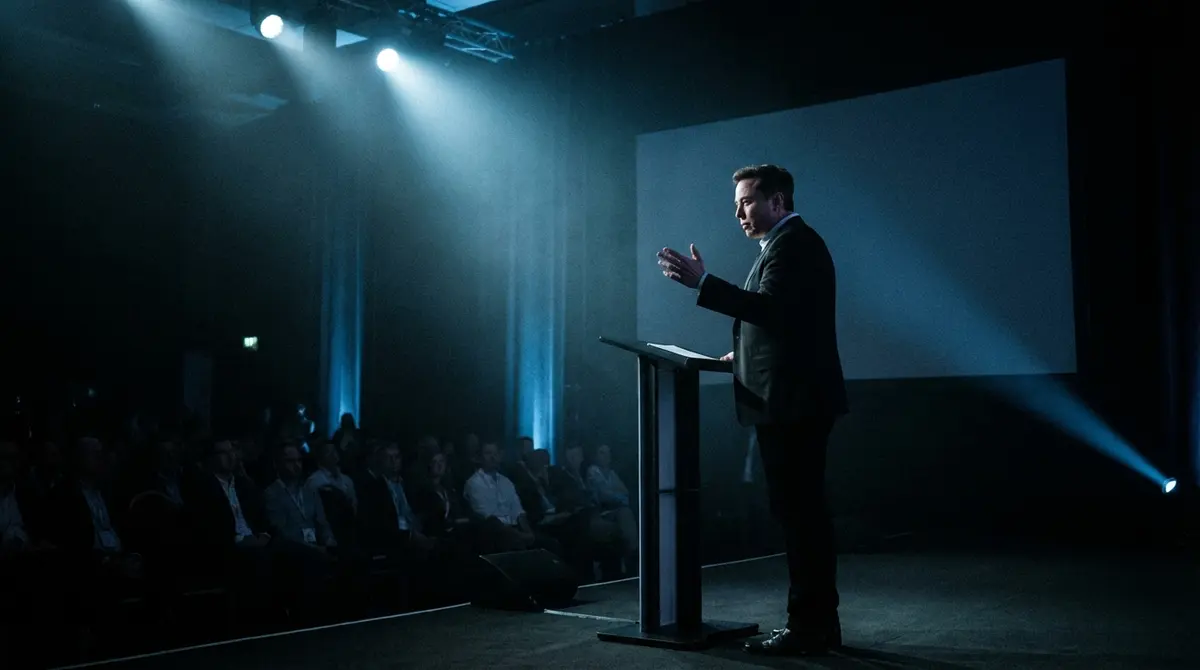
If you thought the race for AI dominance was just about who has the biggest data center in Northern Virginia, you might want to look up. Way up. On Wednesday, February 11, 2026, xAI took the unusual step of publishing a full 45-minute all-hands meeting on X. The video, originally recorded a day prior, didn’t just outline a roadmap for better chatbots—it laid out a literal roadmap to the stars.
The headline news? As of February 2, 2026, SpaceX has officially acquired xAI in a massive stock swap that values the combined entity at roughly $1.25 trillion. This isn’t just a corporate reshuffling; it is a fundamental pivot in how Elon Musk views the constraints of artificial intelligence. By merging the two companies, the goal is to bypass terrestrial energy limits entirely, moving the infrastructure of intelligence off-planet.
But beyond the financial maneuvering, the presentation revealed specific, sci-fi-level details about how this new juggernaut plans to operate, including a tongue-in-cheek jab at Microsoft and a factory on the Moon. Let’s break down what this actually means for the industry.
Why did SpaceX acquire xAI for $1.25 trillion?
To understand this merger, you have to look at the bottlenecks facing AI today: power and cooling. Terrestrial power grids are struggling to keep up with the exponential demand of training clusters. By folding xAI into SpaceX, Musk is betting on a vertical integration strategy that treats rockets and AI models as part of the same machine.
According to the presentation, this is about creating an "innovation engine" capable of solving these physical constraints. The long-term vision involves launching AI satellites into deep space to harvest solar power directly, aiming for a scale of 500 to 1,000 terawatts per year. Musk described this as a move toward a "Kardashev Type II civilization"—a society that can harness the total energy of its star.
The acquisition also serves a financial purpose. With SpaceX preparing for a massive IPO, potentially targeting June 2026, absorbing xAI streamlines access to capital. It creates a behemoth that controls both the compute (xAI) and the transport (SpaceX) required to build this orbital infrastructure. However, it hasn’t been entirely smooth sailing; the research indicates that co-founders Tony Wu and Jimmy Ba have recently departed, leaving the company with only half of its original founding team.
What is the ‘Macrohard’ team and how does it compete with Microsoft?
While space lasers are fun to talk about, the immediate commercial battle is happening right here on Earth. During the restructuring announcement, xAI revealed it is organizing into four core teams: Grok (the chatbot), Coding, Imagine (video generation), and a new division with a name that might sound familiar.
They are calling it "Macrohard."
Led by Toby Pohlen, the Macrohard team is a direct, tongue-in-cheek shot at Microsoft. But the mission is serious. This division is focused on "agentic" computer operation—building AI agents capable of executing any task a human can perform on a computer. This signals an aggressive push to compete with Microsoft and OpenAI in the agentic AI space, moving beyond simple text generation to actual task execution. While the "Imagine" team tackles video and "Grok" handles conversation, Macrohard is seemingly designed to be the hands and fingers of the AI, interacting with software interfaces to get work done.
How does a Moon factory solve AI’s energy crisis?
This is where the presentation went from ambitious to astronomical. Musk didn’t just talk about launching satellites; he announced a plan to build a manufacturing facility on the Moon. The concept involves constructing a factory on the lunar surface to build AI satellites using local resources, then launching them into orbit using a "mass driver"—essentially a giant electromagnetic catapult.
"You have to go to the moon," Musk stated during the all-hands, emphasizing that the ultimate goal is to scale compute to a level that simply isn’t feasible on Earth. The company described this mission as "scaling to make a sentient sun to understand the Universe."
The logic is that space offers unlimited solar energy and a vacuum for cooling, two things that cost billions of dollars to manage in terrestrial data centers. By manufacturing the hardware on the Moon, they avoid the massive cost and fuel requirements of launching heavy infrastructure from Earth’s gravity well.
Looking Ahead
This merger fundamentally changes the risk profile for investors eyeing the upcoming SpaceX IPO in June 2026. By tethering the volatility of AI development to the capital-intensive nature of spaceflight, Musk has created a high-stakes monopoly on the future of compute infrastructure. The losers here could be traditional data center REITs and cloud providers like Amazon and Google, who are bound by Earth’s power grids and regulatory hurdles. If the "Macrohard" team succeeds in shipping reliable agents before the Moon base is even built, Microsoft faces an immediate threat to its enterprise dominance, regardless of whether the lunar factory ever comes online. The message is clear: the next battle for AI supremacy won’t be fought in a server room, but in orbit.
![Illustration related to SpaceX Acquires xAI: The $1.25T Moon Factory Plan [2026]](https://bytewire.press/wp-content/uploads/bytewire-images/2026/02/spacex-acquires-xai-moon-factory-plans-61056786ba.webp)
![Diagram related to SpaceX Acquires xAI: The $1.25T Moon Factory Plan [2026]](https://bytewire.press/wp-content/uploads/bytewire-images/2026/02/spacex-acquires-xai-moon-factory-plans-a8325f5ec6.webp)