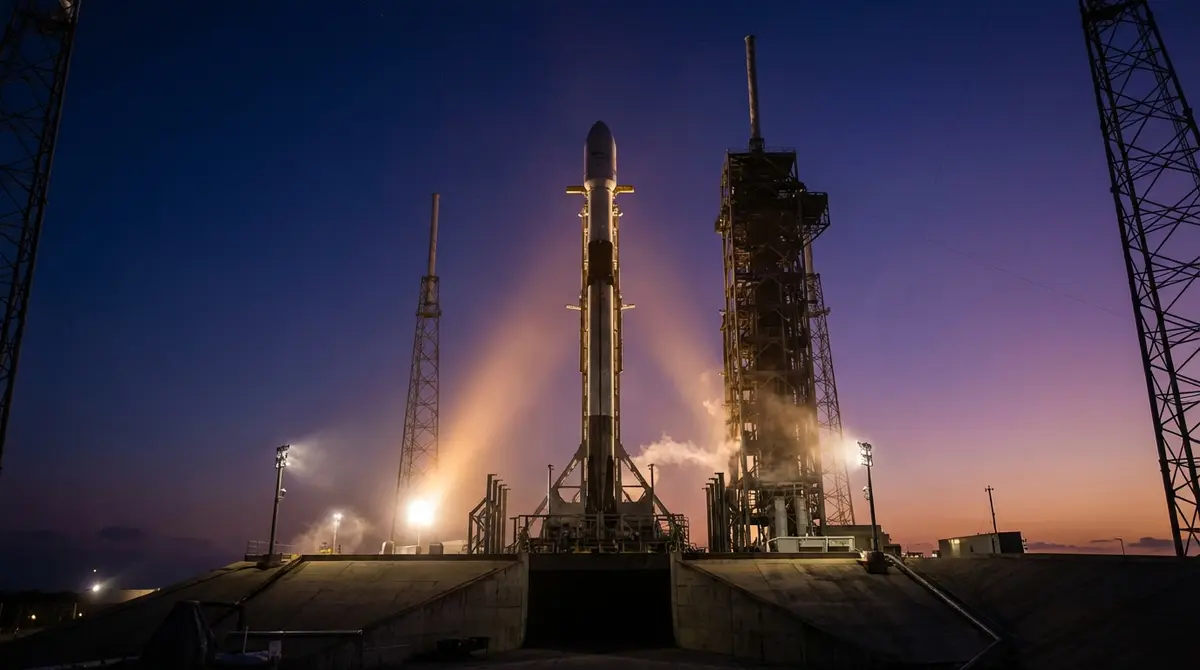
If you still think of rockets as disposable items—like a paper straw or a plastic fork—SpaceX is working very hard to change your mind. On Saturday, February 21, 2026, the company didn’t just launch satellites; it redefined the lifespan of aerospace hardware.
In a display of operational cadence that has become almost routine, SpaceX executed two launches from opposite coasts of the United States within hours of each other. While dual launches are impressive, the real headline comes from the hardware involved. One of the boosters, identified as B1067, successfully completed its 33rd flight. This shatters previous records and pushes the Falcon 9 fleet leader well past the initial expectations of reusability.
For context, just a few years ago, the industry standard was “one and done.” Now, we are looking at orbital class boosters that have seen more action than some commercial airliners do in a month.
What happened during the dual coast-to-coast launches?
The operations on February 21 were a synchronized effort to expand the Starlink megaconstellation. The action kicked off in California and Florida, utilizing two veteran boosters from the SpaceX fleet.
The Florida mission, designated Starlink 6-104, was the record-breaker. Booster B1067 lifted off carrying 28 Starlink satellites, marking its 33rd trip to space and back. Meanwhile, over on the West Coast, the Starlink 17-25 mission launched from California. That flight utilized booster B1063, which is no slouch itself—it successfully completed its 31st flight during this mission, deploying another 25 satellites.
![Illustration related to SpaceX Falcon 9 Reuse Record: 33rd Flight Details [Analysis]](https://bytewire.press/wp-content/uploads/bytewire-images/2026/02/spacex-falcon-9-reuse-record-33rd-flight-starlink-5cdd13b9b6.webp)
Between the two missions, SpaceX added 53 satellites to low Earth orbit in a single day. According to reports, the Starlink constellation now consists of approximately 9,700 active satellites. This massive infrastructure supports a user base that recently surpassed 10 million subscribers globally.
Why does reusable rocketry matter for the average person?
You might be wondering why you should care if a rocket flies 10 times or 33 times. The answer comes down to economics. As industry observers have noted, a booster flying its 31st or 33rd mission isn’t just an engineering flex; it is the economic engine that keeps ticket prices low.
![Diagram related to SpaceX Falcon 9 Reuse Record: 33rd Flight Details [Analysis]](https://bytewire.press/wp-content/uploads/bytewire-images/2026/02/spacex-falcon-9-reuse-record-33rd-flight-starlink-e05384d62a.webp)
Get our analysis in your inbox
No spam. Unsubscribe anytime.