If you have been following the cadence of human spaceflight recently, you know that Launch Complex 39A (LC-39A) at Kennedy Space Center is hallowed ground. It is the departure point that sent Apollo astronauts to the Moon and Space Shuttles into orbit. Since 2014, it has been the primary stage for SpaceX’s Dragon crew missions.
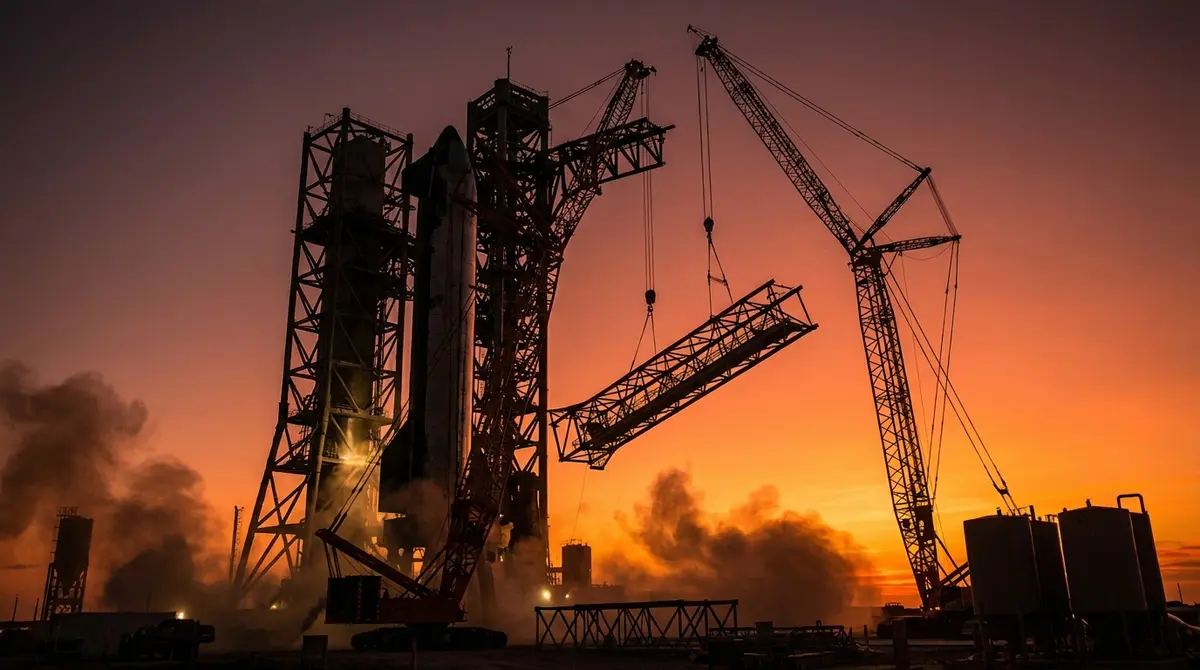
But the scenery at America’s most historic spaceport is changing fast. SpaceX is currently in the process of removing the Dragon crew access arm from LC-39A. This isn’t a downgrade; it is primarily for maintenance (bearing repair). While the arm can be reinstalled if needed, its temporary removal also facilitates the reconfiguration of the pad for the massive infrastructure required by the Starship-Super Heavy system, especially with Falcon 9 and Dragon missions shifting to SLC-40.
This move signals a major pivot in how SpaceX manages its Florida assets, effectively splitting its operations between reliable service missions for NASA and cutting-edge heavy-lift development.
Why is SpaceX removing the crew arm from LC-39A?
The decision to take down the crew arm comes down to physics and real estate. The Starship system is significantly larger and more powerful than the Falcon 9, and it requires specialized ground support equipment that takes up a lot of space. By removing the Falcon-specific crew infrastructure for maintenance, SpaceX is also reducing potential interference for the upcoming heavy-lift campaign, though the arm can be reinstalled if future needs arise.
According to Lee Echerd, SpaceX’s Senior Mission Manager, the plan is to consolidate the company’s workhorse missions elsewhere. "For our manifest going forward, we’re planning to launch most of our Falcon 9 launches off of Space Launch Complex 40," Echerd stated. He clarified that this shift includes "all Dragon missions going forward."
This transition begins immediately, with the upcoming Crew-12 mission scheduled for February 2026 now set to launch from the neighboring Cape Canaveral Space Force Station rather than the historic Kennedy Space Center pad.
Is Space Launch Complex 40 ready for astronauts?
You might be wondering if moving astronaut launches to a different pad introduces new risks. The short answer is no. Space Launch Complex 40 (SLC-40) has been quietly upgraded to handle human spaceflight, providing SpaceX with a fully redundant capability.
SLC-40 was recently certified for human missions, a milestone solidified when the Crew-9 mission successfully launched from there in September 2024. That mission served as a proof-of-concept, demonstrating that SpaceX can maintain its high cadence of crew rotations for NASA without relying on LC-39A.
This redundancy is critical. By having two pads capable of launching crew, SpaceX ensures that work on Starship at LC-39A won’t bottle-neck access to the International Space Station. However, NASA has noted that the door isn’t closed forever. A NASA spokesperson confirmed that if the need arises, "SpaceX could still support NASA crewed launch operations from pad 39A in the future," though for now, the focus is clearly shifting.
When will Starship launch from Florida?
The removal of the crew arm is the precursor to the main event: bringing Starship to the East Coast. Kiko Dontchev, SpaceX’s VP of Launch, emphasized that the recent Starlink 6-99 mission was the "last single stick" Falcon 9 launch from 39A for the foreseeable future. The goal now is "ramping Starship from the Cape."
Regulatory hurdles are already being cleared. In late January 2026, the Federal Aviation Administration (FAA) issued a Record of Decision (ROD) concluding the environmental review for Starship launches from LC-39A. The current timeline targets the initial Florida launches of the Starship-Super Heavy system for late 2026.
To support this, SpaceX is not just modifying the pad; they are building a massive "Gigabay" integration facility at Kennedy Space Center to handle vehicle processing. The FAA license authorizes up to 44 Starship launches annually from the site, signaling an aggressive flight rate once operations come online.
Why are ULA and Blue Origin worried?
While space fans are excited, SpaceX’s neighbors are less enthusiastic. The sheer size of Starship means that when it launches, it requires a massive safety exclusion zone. Competitors United Launch Alliance (ULA) and Blue Origin have both raised concerns with regulators.
Their primary worry is that the safety zones required for Starship operations at LC-39A could disrupt their own launch schedules at nearby pads—specifically ULA’s SLC-41 and Blue Origin’s LC-36. If Starship launches frequently, these competitors fear they could be locked out of their own launch windows, creating a traffic jam in Earth’s busiest space corridor.
Between the Lines
This infrastructure shuffle is a masterclass in risk management. By moving the "bread and butter" NASA crew contracts to the reliable SLC-40, SpaceX isolates its critical revenue stream from the experimental chaos of Starship development. If a Starship test at LC-39A damages the pad—a real possibility with a rocket this powerful—NASA’s access to the ISS remains uninterrupted at the other launch site. SpaceX is effectively telling the industry that Starship is no longer a side project; it is taking over the company’s premier real estate, while the Falcon 9 settles into its role as the dependable utility truck down the road.
![Illustration related to SpaceX LC-39A Crew Arm Removal: Starship Era [Analysis]](https://bytewire.press/wp-content/uploads/bytewire-images/2026/02/spacex-lc-39a-crew-arm-removal-starship-17e20a0421.webp)
![Diagram related to SpaceX LC-39A Crew Arm Removal: Starship Era [Analysis]](https://bytewire.press/wp-content/uploads/bytewire-images/2026/02/spacex-lc-39a-crew-arm-removal-starship-036742e554.webp)