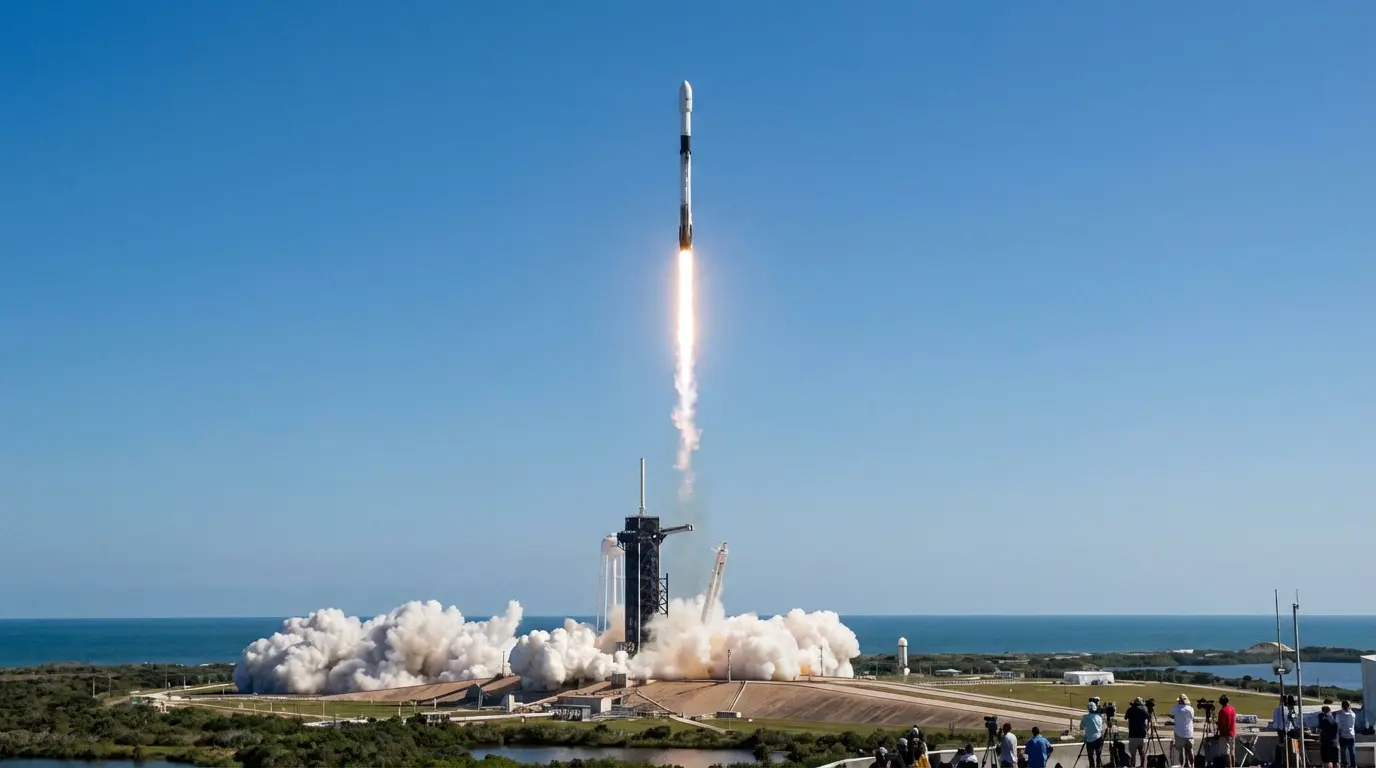
Amazon has secured an agreement for 10 additional launches with SpaceX, acknowledging a critical “near-term shortage in launch capacity” that threatens its satellite deployment timelines. The deal marks a significant expansion of the relationship between the two technology giants, as Amazon seeks to accelerate the deployment of its internet constellation, now reportedly rebranded as Amazon Leo (formerly Project Kuiper). This development comes amidst a broader update on SpaceX’s operations, which includes a new investigation into an upper stage malfunction and the resumption of testing for its massive Starship vehicle.
According to reports, Amazon’s decision to book 10 more Falcon 9 missions is driven by urgent regulatory deadlines and delays in its own supply chain. The company initially sought to diversify its launch providers, booking capacity on vehicles like Blue Origin’s New Glenn, ULA’s Vulcan, and Arianespace’s Ariane 6. However, development delays and manufacturing disruptions with these next-generation heavy-lift vehicles have created an “execution gap.”
As of early 2026, Amazon reportedly has approximately 180 satellites in orbit, far short of the roughly 1,600 required to meet its original July 2026 FCC deadline. Consequently, Amazon has formally requested a 24-month extension from the Federal Communications Commission to push this deployment milestone to July 2028. The booking of 10 additional Falcon 9 flights—on top of three booked in late 2023—appears to be a pragmatic pivot to the only provider currently capable of offering the high-cadence reliable access to space needed to populate the constellation.
While the Falcon 9 fleet handles the immediate commercial workload, SpaceX is also moving forward with its next-generation system. The report indicates that Starship testing is resuming following a period of analysis and ground work. Recent updates suggest that activity has picked up at SpaceX’s Starbase facility, with preparations underway for upcoming flight tests.
The resumption of testing likely involves the latest iterations of the Super Heavy booster and the Starship upper stage, identified in recent tracking as Booster 18 and Ship 39. These vehicles are expected to incorporate upgrades designed to address issues encountered in previous test flights, including hardware changes to improve reliability during the ascent and orbital insertion phases. The industry is watching closely, as a reliable Starship is central to NASA’s Artemis timeline and the future of heavy-lift logistics.
How Serious Is the Upper Stage Malfunction Probe?
The report highlights that SpaceX is currently probing a malfunction involving an upper stage, though specific details on the severity or the specific mission affected remain limited. Such investigations are standard procedure for SpaceX, which relies on a data-driven approach to identify and rectify potential anomalies before they result in mission failure. Given the high flight rate of the Falcon 9—which has become the workhorse for both Amazon’s deployment and SpaceX’s own Starlink network—any investigation into upper stage performance is a matter of significant interest to the broader space industry.
Analysis: The Reality of Launch Scarcity
Amazon’s increased reliance on SpaceX underscores a hard reality in the current launch market: paper rockets cannot launch satellites. For years, Amazon sought to avoid funding its direct competitor by contracting with every major launch provider except SpaceX. However, the persistent delays of New Glenn and Vulcan, combined with strict regulatory ticking clocks, have forced a strategic capitulation. The “near-term shortage” cited by Amazon is not just about the number of rockets available globally, but specifically about the shortage of flight-proven hardware capable of meeting aggressive deployment schedules.
What This Means
This deal cements SpaceX’s position as the singular dominant force in the global launch market for the foreseeable future. For Amazon, it buys time to get its constellation operational and protect its FCC license, even if it means writing checks to a rival. For the wider industry, the investigation into the upper stage malfunction serves as a reminder that even the most reliable systems require constant vigilance, especially when pushing flight cadences to unprecedented levels.
Source: Original Article