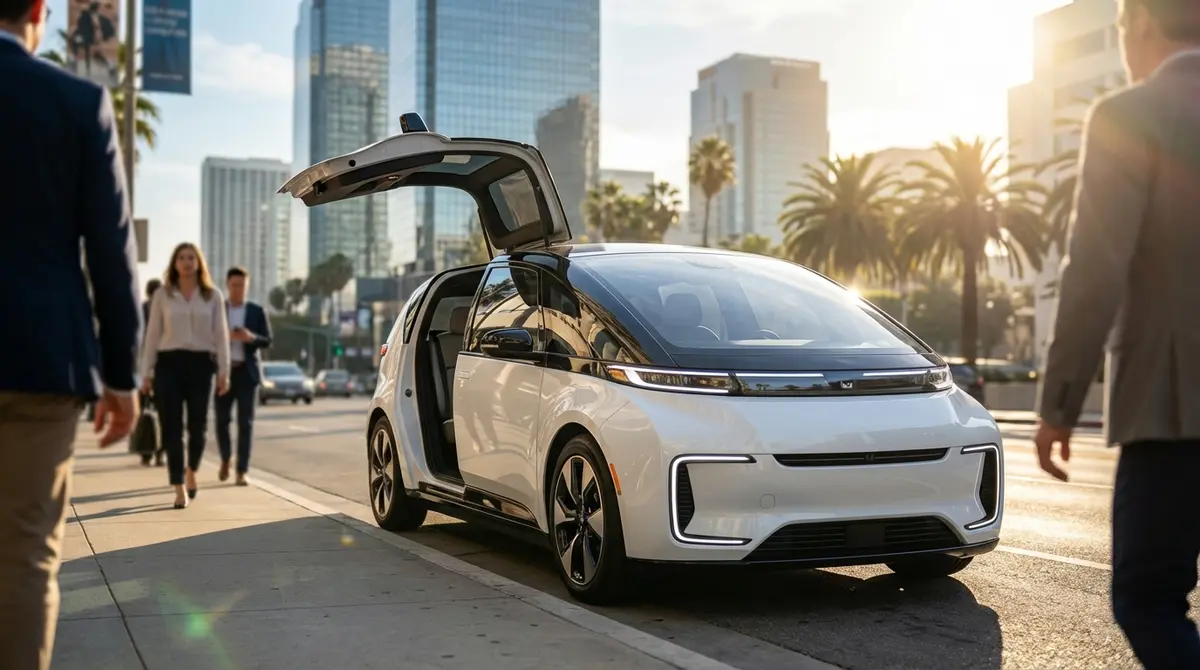
It sounds like the setup to a joke about the future: A billion-dollar autonomous robot gets stuck in traffic because a passenger didn’t close the door hard enough. But for Waymo, this is a very real logistical headache, and they have found a surprisingly low-tech solution to fix it.
According to new reports, the Alphabet-owned autonomous vehicle company is running a pilot program in Atlanta that recruits DoorDash drivers to act as an on-demand rescue squad. Their mission? To drive to a stranded robotaxi and simply shut the door.
This development highlights a fascinating intersection between high-end artificial intelligence and the gritty reality of the gig economy. While the software driving these cars is capable of navigating complex urban environments, it apparently still needs a human hand to deal with the most basic physical interactions.
How does the Waymo and DoorDash pilot work?
The pilot program is currently taking place in Atlanta, where Waymo has already partnered with Uber to offer rides. The premise is straightforward. When a Waymo passenger exits the vehicle and accidentally leaves a door ajar, the car’s safety protocols kick in. The vehicle cannot move, effectively bricking itself in the middle of a drop-off zone or, worse, active traffic.
Traditionally, Waymo would have to dispatch a dedicated fleet response team—employees whose sole job is to drive around and troubleshoot these issues. But that takes time and money.
Under this new system, local DoorDash drivers—known as "Dashers"—receive a job notification directly in their app. Instead of picking up a burrito or a grocery order, the prompt instructs them to "Close a Waymo door." The notification explicitly states that "No pickup or delivery is required."
The payout for this momentary intervention appears to be competitive relative to standard delivery fees. Reports indicate that Dashers can earn approximately $11.25 for completing the task. It is a quick gig: drive to the location, slam the door, and mark the job as complete.
Why is Waymo outsourcing technical support?
This move represents a significant shift in how autonomous vehicle companies view field support. It is essentially the "gigification" of maintenance. By leveraging the massive density of DoorDash drivers already swarming city streets, Waymo can theoretically resolve these physical edge cases much faster than they could with a centralized team.
In a joint statement to 404 Media, the companies explained that this system allows Waymo to "get its vehicles back on the road quickly" in the rare event a door is left ajar. It is a numbers game; there are likely far more Dashers near a stranded robotaxi at any given moment than there are Waymo fleet technicians.
This isn’t the only place Waymo is testing this hybrid support model. In Los Angeles, the company utilizes a service called "Honk," a roadside assistance platform. In that market, gig workers are reportedly paid between $20 and $24 for tasks that can range from closing doors to towing vehicles. The Atlanta pilot with DoorDash seems to be a natural evolution of this strategy, tapping into an even larger labor pool.
Is the dream of fully driverless cars stalling?
The reliance on gig workers underscores a persistent reality in the autonomous vehicle industry: "driverless" does not mean "humanless." We often focus on the software challenges of self-driving cars—detecting pedestrians, merging onto highways, or navigating construction zones. However, the physical hardware remains a hurdle.
Until robotaxis are equipped with automatic door-closing mechanisms (which adds weight, cost, and complexity) or robotic arms to fix themselves, they remain vulnerable to human error. A passenger forgetting to latch a door is a minor inconvenience for a human Uber driver, who can just reach back and fix it. For a robot, it is a paralyzing event.
It is worth noting that Waymo and DoorDash have a history of collaboration. In October 2025, the two companies announced a partnership in Phoenix to use Waymo vehicles for autonomous food delivery. The Atlanta pilot, however, flips the dynamic: instead of the robot doing the work for the delivery network, the delivery network is doing the work for the robot.
What This Really Means
This pilot program is a tacit admission that the economics of dedicated fleet support teams are unsustainable for scaling robotaxis. By outsourcing minor physical interventions to the gig economy, Waymo is effectively turning maintenance into a variable cost rather than a fixed one. It benefits Waymo by reducing overhead and downtime, and it benefits Dashers by offering quick, low-effort gigs. However, it also signals that the industry is moving toward a permanent "hybrid" model where autonomy is maintained by a shadow workforce of low-paid humans, debunking the myth that automation simply replaces labor—often, it just displaces and fragments it.
![Illustration related to Waymo Paying DoorDash Drivers to Rescue Robotaxis [Report]](https://bytewire.press/wp-content/uploads/bytewire-images/2026/02/waymo-doordash-drivers-closing-doors-pilot-1aec6dea42.webp)
![Diagram related to Waymo Paying DoorDash Drivers to Rescue Robotaxis [Report]](https://bytewire.press/wp-content/uploads/bytewire-images/2026/02/waymo-doordash-drivers-closing-doors-pilot-e1026e8018.webp)